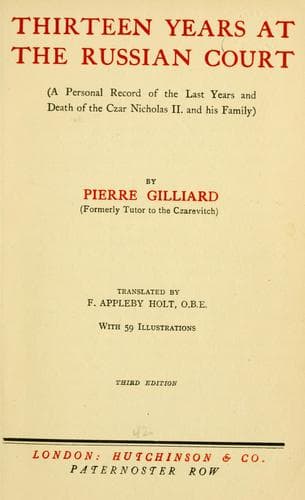
Thirteen years at the Russian court: (a personal record of the last years and death of the Czar Nicholas II. and his family)Gilliard, Pierre
History
Thirteen years at the Russian court: (a personal record of the last years and death of the Czar Nicholas II. and his family)
Gilliard, Pierre
Nicholas II, Emperor of Russia, 1868-1918; Romanov, House of; Soviet Union -- History -- Revolution, 1917-1921 -- Personal narratives
Very reserved and yet very impulsive, the Czarina, first and foremost
the wife and mother, was never happy except in the bosom of her family.
She was artistic and well-educated, and liked reading and the arts. She
was fond of meditation, and often became wholly absorbed in her own
inward thoughts and feelings, an absorption from which she would only
emerge when danger threatened. She would throw herself at the obstacle
with all the ardour of a passionate nature. She was endowed with the
finest moral qualities, and was always inspired by the highest ideals.
But her sorrows had broken her. She was but the shadow of her former
self, and she often had periods of mystic ecstasy in which she lost all
sense of reality. Her faith in Rasputin proves it beyond a doubt.
It was thus that in her desire to save her husband and son, whom she
loved more than life itself, she forged with her own hands the
instrument of their undoing.
CHAPTER XII
NICHOLAS II. AS COMMANDER-IN-CHIEF--THE ARRIVAL OF THE CZAREVITCH AT
G.H.Q.--VISITS TO THE FRONT
(SEPTEMBER--DECEMBER, 1915)
The Grand-Duke Nicholas left G.H.Q. on September 7th, two days after the
arrival of the Czar. He left for the Caucasus, taking with him General
Yanushkevitch, who had been replaced as First Quartermaster-General of
the Russian armies by General Alexeieff a short time before. This
appointment had been very well received by military circles, who had
high hopes of Alexeieff. He it was who had drawn up the plan of campaign
in Galicia in the autumn of 1914, and as Commander of the North-Western
Front he had just given further proof of his military talent. The burden
which was now laid upon his shoulders was a crushing one, for as a
result of the irresistible advance of the Germans the Russian army was
in a very critical position, and the decisions which he had to take were
exceptionally grave. From the outset the Czar gave him an entirely free
hand with regard to the operations, confining himself to covering him
with his authority and taking responsibility for everything he did.
A few days after Nicholas II. took over the Supreme Command the
situation suddenly took a turn for the worse. The Germans, who had
massed large forces north-west of Vilnam, had succeeded in breaking the
Russian front, and their cavalry was operating in the rear of the army
and threatening its communications. On September 18th we seemed on the
verge of a great disaster.
Thanks to the skill of the dispositions which were taken and the
endurance and heroism of the troops, the peril was averted. This was the
last effort of the enemy, who himself had shot his bolt. In the early
days of October the Russians in turn gained a success over the
Austrians, and gradually the immense front became fixed and both sides
went to ground.
Public-domain text, read in full here on John Shaqi.
Reviews
Reviews
No reviews yet
Be the first to share your thoughts on this work.
Elsewhere in the archive
Join the Discussion
Join the discussion
Sign in to leave a comment or review.
Sign InorCreate an account