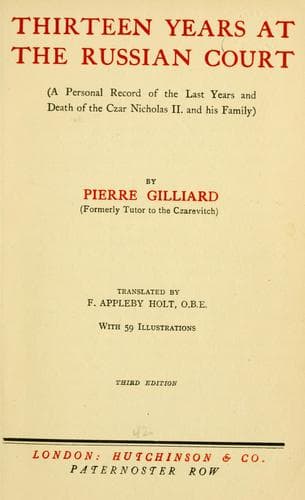
Thirteen years at the Russian court: (a personal record of the last years and death of the Czar Nicholas II. and his family)Gilliard, Pierre
History
Thirteen years at the Russian court: (a personal record of the last years and death of the Czar Nicholas II. and his family)
Gilliard, Pierre
Nicholas II, Emperor of Russia, 1868-1918; Romanov, House of; Soviet Union -- History -- Revolution, 1917-1921 -- Personal narratives
It is not true that personal ambition or a thirst for power induced the
Czarina to intervene in political affairs. Her motive was purely
sentimental. She worshipped her husband as she worshipped her children,
and there was no limit to her devotion for those she loved. Her only
desire was to be useful to the Czar in his heavy task and to help him
with her counsel.
Convinced that autocracy was the only form of government suited to the
needs of Russia, the Czarina believed that any great concessions to
liberal demands were premature. In her view the uneducated masses of the
Russian people could be galvanised into action only by a Czar in whose
person all power was centralised. She was certain that to the _moujik_
the Czar was the symbol of the unity, greatness, and glory of Russia,
the head of the state and the Lord’s Anointed. To encroach on his
prerogatives was to undermine the faith of the Russian peasant and to
risk precipitating the worst disasters for the country. The Czar must
not merely rule: he must govern the state with a firm and mighty hand.
To the new task the Czarina brought the same devotion, courage, and,
alas! blindness she had shown in her fight for the life of her son. She
was at any rate logical in her errors. Persuaded, as she was, that the
only support for the dynasty was the nation, and that Rasputin was God’s
elect (had she not witnessed the efficacy of his prayers during her
son’s illness?), she was absolutely convinced that this lowly peasant
could use his supernatural powers to help him who held in his hands the
fate of the empire of the Czars.
Cunning and astute as he was, Rasputin never advised in political
matters except with the most extreme caution. He always took the
greatest care to be very well informed as to what was going on at Court
and as to the private feelings of the Czar and his wife. As a rule,
therefore, his prophecies only confirmed the secret wishes of the
Czarina. In fact, it was almost impossible to doubt that it was she who
inspired the “inspired,” but as her desires were interpreted by
Rasputin, they seemed in her eyes to have the sanction and authority of
a revelation.
Before the war the influence of the Czarina in political affairs had
been but intermittent. It was usually confined to procuring the
dismissal of anyone who declared his hostility to the _staretz_. In the
first months of the war there had been no change in that respect, but
after the great reverses in the spring of 1915, and more particularly
after the Czar had assumed command of the army, the Czarina played an
ever-increasing part in affairs of state because she wished to help her
husband, who was overwhelmed with the burden of his growing
responsibilities. She was worn out, and desired nothing more than peace
and rest, but she willingly sacrificed her personal comfort to what she
believed was a sacred duty.
Public-domain text, read in full here on John Shaqi.
Reviews
Reviews
No reviews yet
Be the first to share your thoughts on this work.
Elsewhere in the archive
Join the Discussion
Join the discussion
Sign in to leave a comment or review.
Sign InorCreate an account