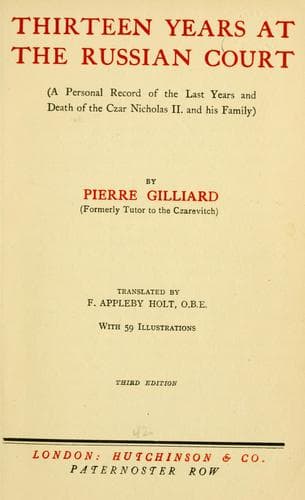
Thirteen years at the Russian court: (a personal record of the last years and death of the Czar Nicholas II. and his family)Gilliard, Pierre
History
Thirteen years at the Russian court: (a personal record of the last years and death of the Czar Nicholas II. and his family)
Gilliard, Pierre
Nicholas II, Emperor of Russia, 1868-1918; Romanov, House of; Soviet Union -- History -- Revolution, 1917-1921 -- Personal narratives
and wearing the huge fur caps which make them look so fierce. As we
started to return, the whole mass of cavalry suddenly moved forward,
took station on both sides of the road, broke into a gallop, tearing up
the hills, sweeping down the banks of ravines, clearing all obstacles,
and thus escorted us to the station in a terrific charge in which men
and animals crashed together on the ground while above the _mêlée_ rose
the raucous yells of the Caucasian mountaineers. It was a spectacle at
once magnificent and terrible which revealed all the savage instincts of
this primitive race.
We did not return to G.H.Q. until November 26th, after having visited
practically the whole of the immense front from the Baltic to the Black
Sea.
* * * * *
On December 10th we heard that the Czar was intending to visit the
regiments of the Guard which were then on the frontier of Galicia. On
the morning of our departure, Thursday, December 16th, Alexis
Nicolaïevitch, who had caught cold the previous day and was suffering
from a heavy catarrh in the head, began to bleed at the nose as a result
of sneezing violently. I summoned Professor Fiodrof,[40] but he could
not entirely stop the bleeding. In spite of this accident we started
off, as all preparations had been made for the arrival of the Czar.
During the night the boy got worse. His temperature had gone up and he
was getting weaker. At three o’clock in the morning Professor Fiodrof,
alarmed at his responsibilities, decided to have the Czar roused and ask
him to return to Mohileff, where he could attend to the Czarevitch under
more favourable conditions.
The next morning we were on our way back to G.H.Q., but the boy’s state
was so alarming that it was decided to take him back to Tsarskoïe-Selo.
The Czar called on the General Staff and spent two hours with General
Alexeieff. Then he joined us and we started off at once. Our journey was
particularly harrowing, as the patient’s strength was failing rapidly.
We had to have the train stopped several times to be able to change the
plugs. Alexis Nicolaïevitch was supported in bed by his sailor Nagorny
(he could not be allowed to lie full length), and twice in the night he
swooned away and I thought the end had come.
Towards morning there was a slight improvement, however, and the
hæmorrhage lessened. At last we reached Tsarskoïe-Selo. It was eleven
o’clock. The Czarina, who had been torn with anguish and anxiety, was on
the platform with the Grand-Duchesses. With infinite care the invalid
was taken to the palace. The doctors ultimately succeeded in cauterizing
the scar which had formed at the spot where a little blood-vessel had
burst. Once more the Czarina attributed the improvement in her son’s
condition that morning to the prayers of Rasputin, and she remained
convinced that the boy had been saved thanks to his intervention.
Public-domain text, read in full here on John Shaqi.
Reviews
Reviews
No reviews yet
Be the first to share your thoughts on this work.
Elsewhere in the archive
Join the Discussion
Join the discussion
Sign in to leave a comment or review.
Sign InorCreate an account