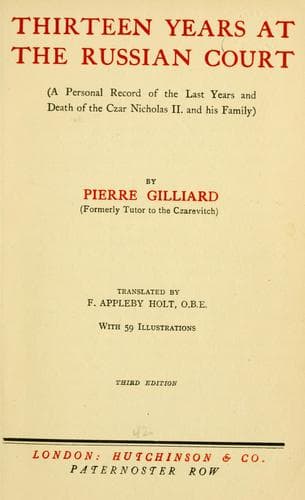
Thirteen years at the Russian court: (a personal record of the last years and death of the Czar Nicholas II. and his family)Gilliard, Pierre
History
Thirteen years at the Russian court: (a personal record of the last years and death of the Czar Nicholas II. and his family)
Gilliard, Pierre
Nicholas II, Emperor of Russia, 1868-1918; Romanov, House of; Soviet Union -- History -- Revolution, 1917-1921 -- Personal narratives
The Czar stayed several days with us, but he was anxious to get away as
he was wishful to take advantage of the comparative stagnation at the
front to visit the troops and get into the closest possible touch with
them.
His journeys to the front had been a great success. His presence had
everywhere aroused immense enthusiasm, not only among the men but also
among the peasants, who swarmed in from the country round whenever his
train stopped, in the hope of catching a glimpse of their sovereign.
The Czar was certain that his efforts would tend to revive feelings of
patriotism and personal loyalty in the nation and the army. His recent
experiences persuaded him that he had succeeded, and those who went with
him thought the same. Was it an illusion? He who denies its truth can
know little of the Russian people, and cannot have the slightest idea
how deep-rooted was monarchical sentiment in the _moujik_.
CHAPTER XIII
THE CZAR AT THE DUMA--THE CAMPAIGN IN GALICIA--OUR LIFE AT
G.H.Q.--GROWING DISAFFECTION IN THE REAR
(1916)
The Czar had returned to G.H.Q. alone on December 25th, and three days
later he reviewed on the Galician frontier the divisions of the Guard
which had been concentrated in view of an imminent offensive. The
absence of Alexis Nicolaïevitch was a real sorrow to him, as he had been
looking forward eagerly to presenting him to his Guard. He had then
returned to Mohileff.
Towards the end of the year 1915 the military situation of the Russians
had greatly improved. The army had taken advantage of the quiet months
which followed the conclusion of the great German offensive at the end
of September, 1915, and, thanks to the enormous reserves in man-power at
the disposal of the country, it had easily made good the very heavy
losses it had suffered in the retreat. Once more the Germans found
themselves baulked of the great prize they had promised themselves--a
prize which their brilliant successes at the opening of the campaign
seemed to have assured. They had growing doubts about their ability to
overcome the stubborn Russian resistance by arms, and by clever
propaganda and cunning intrigues they were now endeavouring to stir up
such disaffection in the interior of the country as would hasten, they
hoped, the consummation so devoutly to be desired. But in the person of
the Czar they found an insurmountable obstacle to the realisation of
their designs. That obstacle must be removed.
Public-domain text, read in full here on John Shaqi.
Reviews
Reviews
No reviews yet
Be the first to share your thoughts on this work.
Elsewhere in the archive
Join the Discussion
Join the discussion
Sign in to leave a comment or review.
Sign InorCreate an account