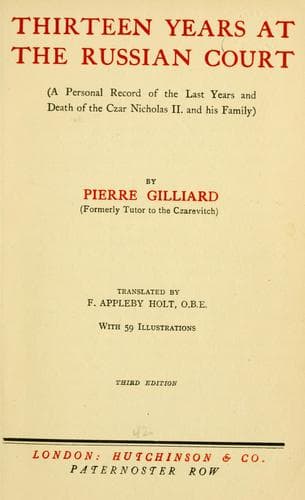
Thirteen years at the Russian court: (a personal record of the last years and death of the Czar Nicholas II. and his family)Gilliard, Pierre
History
Thirteen years at the Russian court: (a personal record of the last years and death of the Czar Nicholas II. and his family)
Gilliard, Pierre
Nicholas II, Emperor of Russia, 1868-1918; Romanov, House of; Soviet Union -- History -- Revolution, 1917-1921 -- Personal narratives
The morning after his arrival the Czar carried out his intention of
going with his brother, the Grand-Duke Michael, to the Tauride Palace,
where the Duma was to resume its labours that day. It was the first time
that the representatives of the nation had received a visit from their
sovereign, and in political circles great importance was attached to
this historical event. It bore witness to the Czar’s ardent desire for
closer co-operation with the people’s representatives, and the step was
particularly warmly welcomed, as confidence in the Government had been
shaken as the result of the reverses suffered by the army and the
crushing charges made against the former Minister of War, General
Sukhomlinoff.
The Czar was received on his arrival at the Tauride Palace by M.
Rodzianko, President of the Duma, who conducted him into the Catherine
Hall, where he was present at a _Te Deum_ to celebrate the capture of
Erzerum. Then turning to the deputies, the Czar expressed his great
pleasure at being among them, and voiced his absolute conviction that in
the tragic days through which Russia was passing they would all unite
their efforts and work together in perfect harmony for the welfare of
the country. His words were received with vociferous cheers.
The Czar withdrew after a visit to the chambers and offices of the
Tauride Palace. Half an hour later the President, in opening the
session, ended his speech with these words:
“The direct association of the Czar with his people, that benefit which
is inestimable and indispensable to the prosperity of the Russian
Empire, is now strengthened by a tie which is still more potent. This
good news will fill all hearts with, joy even in the remotest corners of
our land, and give fresh courage to our glorious soldiers, the defenders
of their country.”
On that memorable day it seemed that the sovereign, the Ministers, and
the representatives of the nation had one thought, and one thought
alone--to conquer at whatever cost.
The same evening the Czar went to the Council of State, which was also
resuming its labours that day. Then he returned to Tsarskoïe-Selo, which
he left next morning for G.H.Q. This was the time of the great onslaught
on Verdun, and it was essential that Russia should intervene without
delay in order to draw a larger portion of the German forces upon
herself. It was decided to take the offensive.
The attack was launched about March 15th in the Dvinsk and Vilna
sectors, and at first it was crowned with success, but the progress of
the Russians was slow, for the Germans offered a very stubborn
resistance. There had been a thaw, the roads were almost impracticable,
and the men had to wade through mud and marsh. The attack died down
about the beginning of April and soon came to a standstill. Yet the
diversion had borne fruit, for the Germans had found themselves
compelled to send considerable reinforcements to the threatened sectors.
* * * * *
Public-domain text, read in full here on John Shaqi.
Reviews
Reviews
No reviews yet
Be the first to share your thoughts on this work.
Elsewhere in the archive
Join the Discussion
Join the discussion
Sign in to leave a comment or review.
Sign InorCreate an account