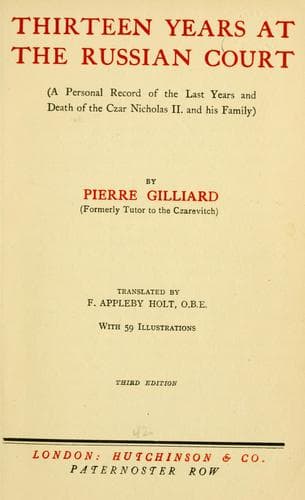
Thirteen years at the Russian court: (a personal record of the last years and death of the Czar Nicholas II. and his family)Gilliard, Pierre
History
Thirteen years at the Russian court: (a personal record of the last years and death of the Czar Nicholas II. and his family)
Gilliard, Pierre
Nicholas II, Emperor of Russia, 1868-1918; Romanov, House of; Soviet Union -- History -- Revolution, 1917-1921 -- Personal narratives
By assuming the command of his troops and thus staking his crown on the
struggle, the Czar had definitely deprived his enemies of all hopes of a
reconciliation. At Berlin the authorities now knew that Nicholas II.
would stand by his allies to the bitter end, and that all attempts at a
_rapprochement_ would be broken against his unswerving determination to
continue the war at any cost. They also knew that the Czar was the sole
bond between the different parties in the Empire, and that once it was
removed no organised power would be capable of averting dismemberment
and anarchy.
The German General Staff therefore devoted itself unceasingly to ruin
the prestige of the monarchy and bring about the downfall of the Czar.
To attain that object the essential step was to compromise the Czar in
the eyes of his people and his allies. Germany had in Russia many
sources of intelligence and powerful means of action, and she devoted
herself to spreading the idea that the Czar was thinking of liquidating
the war and making a separate peace.
The Czar decided to nip these intrigues in the bud and to define his
intentions beyond doubt. On January 2nd, at Zamirie, where he was
inspecting the regiments of General Kuropatkin’s army, he ended his
address to the troops with the following formal declaration:
“You need have no fear. As I announced at the beginning of the war, I
will not make peace until we have driven the last enemy soldier beyond
our frontiers, nor will I conclude peace except by agreement with our
allies, to whom we are bound not only by treaties but by sincere
friendship and the blood spilt in a common cause.”
Nicholas II. thus confirmed in the presence of his army that solemn
compact which had been entered upon on August 2nd, 1914, and renewed
when he had become Commander-in-Chief of the Russian armies. The
Government was anxious to give the widest possible publicity to the
Czar’s speech, and had it printed and distributed among the armies and
in the country districts.
In January and February the Czar continued his visits to the front and
G.H.Q. (it was at Mohileff that he spent the Russian New Year), and
returned to Tsarskoïe-Selo on February 21st, the day before the opening
of the Duma. Five days before, the news of the capture of the fortress
of Erzerum, which had so long been the backbone of the Turkish
resistance, had caused great joy throughout Russia. It was certainly a
fine success, and the offensive of the army of the Caucasus continued to
make rapid headway.
Public-domain text, read in full here on John Shaqi.
Reviews
Reviews
No reviews yet
Be the first to share your thoughts on this work.
Elsewhere in the archive
Join the Discussion
Join the discussion
Sign in to leave a comment or review.
Sign InorCreate an account