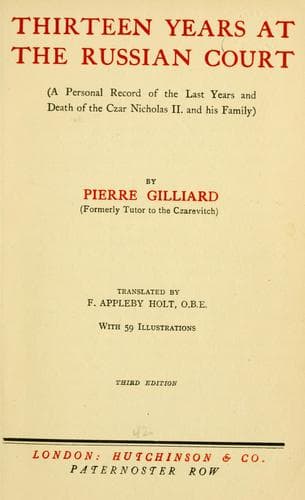
Thirteen years at the Russian court: (a personal record of the last years and death of the Czar Nicholas II. and his family)Gilliard, Pierre
History
Thirteen years at the Russian court: (a personal record of the last years and death of the Czar Nicholas II. and his family)
Gilliard, Pierre
Nicholas II, Emperor of Russia, 1868-1918; Romanov, House of; Soviet Union -- History -- Revolution, 1917-1921 -- Personal narratives
Nicolaïevitch’s studies and was also bad for his health. The impressions
he gained there were too numerous and exciting for so delicate a nature
as his. He became nervous, fretful, and incapable of useful work. I told
the Czar what I thought. He admitted that my objections were well
founded, but suggested that these drawbacks were compensated for by the
fact that his son was losing his timidity and natural wildness, and that
the sight of all the misery he had witnessed would give him a salutary
horror of war for the rest of his life.
But the longer we stayed at the front the stronger was my conviction
that it was doing the Czarevitch a lot of harm. My position was becoming
difficult, and on two or three occasions I had to take strong steps with
the boy. I had an idea that the Czar did not entirely approve, and did
not back me up as much as he might have done. As I was extremely tired
by my work in the last three years--I had had no holiday since
September, 1913--I decided to ask for a few weeks’ leave. My colleague,
M. Petroff, came to take my place, and I left General Headquarters on
July 14th.
As soon as I arrived at Tsarskoïe-Selo the Czarina summoned me, and I
had a long talk with her, in the course of which I tried to show the
grave disadvantages for Alexis Nicolaïevitch of his long visits to the
front. She replied that the Czar and herself quite realised them, but
thought that it was better to sacrifice their son’s education
temporarily, even at the risk of injuring his health, than to deprive
him of the other benefits he was deriving from his stay at Mohileff.
With a candour which utterly amazed me she said that all his life the
Czar had suffered terribly from his natural timidity and from the fact
that as he had been kept too much in the background he had found himself
badly prepared for the duties of a ruler on the sudden death of
Alexander III. The Czar had vowed to avoid the same mistakes in the
education of his son.
I realised that I had come up against a considered decision, and was not
likely to secure any modification. All the same, it was agreed that
Alexis Nicolaïevitch’s lessons should be resumed on a more regular plan
at the end of September, and that I should receive some assistance in my
work.
When our conversation was over the Czarina made me stay behind to
dinner. I was the only guest that evening. After the meal we went out on
the terrace. It was a beautiful summer evening, warm and still. Her
Majesty was stretched on a sofa, and she and two of her daughters were
knitting woollen clothing for the soldiers. The two other
Grand-Duchesses were sewing. Alexis Nicolaïevitch was naturally the
principal topic of conversation. They never tired of asking me what he
did and said. I spent an hour thus in this homely and quiet circle,
suddenly introduced into the intimacy of that family life which
etiquette had forbidden me from entering, save in this casual and rare
fashion.
* * * * *
Public-domain text, read in full here on John Shaqi.
Reviews
Reviews
No reviews yet
Be the first to share your thoughts on this work.
Elsewhere in the archive
Join the Discussion
Join the discussion
Sign in to leave a comment or review.
Sign InorCreate an account