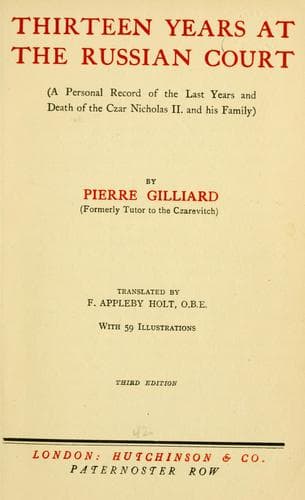
Thirteen years at the Russian court: (a personal record of the last years and death of the Czar Nicholas II. and his family)Gilliard, Pierre
History
Thirteen years at the Russian court: (a personal record of the last years and death of the Czar Nicholas II. and his family)
Gilliard, Pierre
Nicholas II, Emperor of Russia, 1868-1918; Romanov, House of; Soviet Union -- History -- Revolution, 1917-1921 -- Personal narratives
In the days following I spent my time in a round of visits and renewing
relationships which my journeys to the front had compelled me to
neglect. I thus saw people in different strata of society in the
capital, and was not slow to realise that far-reaching changes had taken
place in public opinion in recent months. People did not confine
themselves to violent attacks on the Government, but went on to attack
the person of the Czar.
Since that memorable February 22nd on which Nicholas II. had presented
himself to the Duma in his sincere desire for reconciliation, the
differences between the sovereign and the representatives of the nation
had only increased. The Czar had long been hesitating to grant the
liberal concessions which had been demanded. He considered it was the
wrong time, and that it was dangerous to attempt reforms while the war
was raging. It was not that he clung to his autocratic personal
prerogatives, for he was simplicity and modesty itself, but he feared
the effect such radical changes might have at so critical a moment. When
the Czar declared on February 22nd that he was happy to be among the
representatives of his people, the Czar had spoken his real thoughts. In
inviting them to unite all their efforts for the welfare of the country
in the tragic days through which it was passing, he was urging them to
forget all their political differences and have only one goal--victory
and belief in their Czar until the end of the war.
Why did he not make a solemn promise that day to give the nation the
liberties they asked as soon as circumstances permitted? Why did he not
try to recover by his acts that confidence of the Duma which he felt he
was losing? The answer is that those around him had made it impossible
for him to find out for himself what was really going on in the country.
The Czar’s visit to the Tauride Palace had given rise to great hopes.
They had not been fulfilled, and men were not slow to see that nothing
had been changed. The conflict with the Government was immediately
resumed. The demands became more pressing and recrimination more
violent. Frightened by the false reports of those who abused his
confidence, the Czar began to regard the opposition of the Duma as the
result of revolutionary agitation, and thought he could re-establish his
authority by measures which only swelled the general discontent.
Public-domain text, read in full here on John Shaqi.
Reviews
Reviews
No reviews yet
Be the first to share your thoughts on this work.
Elsewhere in the archive
Join the Discussion
Join the discussion
Sign in to leave a comment or review.
Sign InorCreate an account