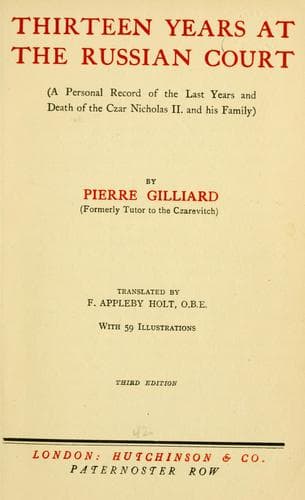
Thirteen years at the Russian court: (a personal record of the last years and death of the Czar Nicholas II. and his family)Gilliard, Pierre
History
Thirteen years at the Russian court: (a personal record of the last years and death of the Czar Nicholas II. and his family)
Gilliard, Pierre
Nicholas II, Emperor of Russia, 1868-1918; Romanov, House of; Soviet Union -- History -- Revolution, 1917-1921 -- Personal narratives
He had hardly left the capital before the first symptoms of insurrection
began to be observable in the working-class quarters. The factories went
on strike, and the movement spread rapidly during the days following.
The population of Petrograd had suffered great privations during the
winter, for owing to the shortage of rolling-stock the transport of food
and fuel had become very difficult, and there was no sign of improvement
in this respect. The Government could think of nothing likely to calm
the excitement, and Protopopoff merely exasperated everyone by the
measures of repression--as stupid as criminal--taken by the police.
Troops also had been employed. All the regiments being at the front, the
only troops at Petrograd were units under instruction, whose loyalty had
been thoroughly undermined by organised propaganda in the barracks in
spite of counter-measures. There were cases of defection, and after
three days of half-hearted resistance unit after unit went over to the
insurgents. By the 13th the city was almost entirely in the hands of the
revolutionaries, and the Duma proceeded to form a provisional
government.
At first we at Mohileff had no idea of the scale of the events which had
occurred at Petrograd. Yet after Saturday, March 10th, General Alexeieff
and some officers of the Czar’s suite had tried to open his eyes and
persuade him to grant the liberties the nation demanded immediately. But
once more Nicholas II. was deceived by the intentionally incomplete and
inaccurate statements of a few ignorant individuals in his suite[56] and
would not take their advice.
By the 12th it was impossible to conceal the truth from the Czar any
longer; he understood that extraordinary measures were required, and
decided to return to Tsarskoïe-Selo at once.
The Imperial train left Mohileff on the night of the 12th, but on
arriving at the station of Malaia-Vichera twenty-four hours later it was
ascertained that the station of Tosno, thirty miles south of Petrograd,
was in the hands of the insurgents, and that it was impossible to get to
Tsarskoïe-Selo. There was nothing for it but to turn back.
The Czar decided to go to Pskoff to General Russky, the
Commander-in-Chief of the Northern Front. He arrived there on the
evening of the 14th. When the General had told him the latest
developments in Petrograd the Czar instructed him to inform M. Rodzianko
by telephone that he was ready to make every concession if the Duma
thought that it would tranquillise the nation. The reply came: “It is
too late.”
Was it really so? The revolutionary movement was confined to Petrograd
and its suburbs; in spite of propaganda, the Czar still enjoyed
considerable prestige in the army, and his authority with the peasants
was intact. Would not the grant of a Constitution and the help of the
Duma have been enough to restore to Nicholas II. the popularity he had
enjoyed at the beginning of the war?
Public-domain text, read in full here on John Shaqi.
Reviews
Reviews
No reviews yet
Be the first to share your thoughts on this work.
Elsewhere in the archive
Join the Discussion
Join the discussion
Sign in to leave a comment or review.
Sign InorCreate an account