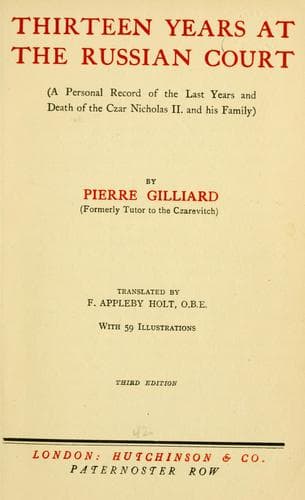
Thirteen years at the Russian court: (a personal record of the last years and death of the Czar Nicholas II. and his family)Gilliard, Pierre
History
Thirteen years at the Russian court: (a personal record of the last years and death of the Czar Nicholas II. and his family)
Gilliard, Pierre
Nicholas II, Emperor of Russia, 1868-1918; Romanov, House of; Soviet Union -- History -- Revolution, 1917-1921 -- Personal narratives
The British Ambassador, getting his information from Russian politicians
whose patriotism was above suspicion, but who saw their country as they
wanted it to be and not as it really was, allowed himself to be led
astray. Insufficient account was taken of the special conditions which
made Russia a religious, political, and social anachronism to which none
of the formulæ or panaceas of Western Europe would apply. They forgot
that in any country at war the early stages of a revolution almost
always produce a weakening of the national effort and adversely affect
the fighting power of the army. In a country like Russia this would be
true to a far greater extent. The Entente made a mistake[54] in thinking
that the movement which the beginning of February, 1917, revealed was of
popular origin. It was nothing of the kind, and only the governing
classes participated in it. The great masses stood aloof. It is not true
that it was a fundamental upheaval which overturned the monarchy. It was
the fall of the monarchy itself which raised that formidable wave which
engulfed Russia and nearly submerged the neighbouring states.
* * * * *
After his return from G.H.Q. the Czar had remained at Tsarskoïe-Selo for
the months of January and February. He felt that the political situation
was more and more strained, but he had not yet lost all hope. The
country was suffering: it was tired of the war and anxiously longing for
peace. The opposition was growing from day to day, and the storm was
threatening, but in spite of everything Nicholas II. hoped that
patriotic feeling would carry the day against the pessimism which the
trials and worries of the moment made general, and that no one would
risk compromising the results of a war which had cost the nation so much
by rash and imprudent action.
His faith in his army was also unshaken. He knew that the material sent
from France and England was arriving satisfactorily and would improve
the conditions under which it had to fight. He had the greatest hopes of
the new formations which had been created in the course of the
winter.[55] He was certain that his army would be ready in the spring to
join in that great offensive of the Allies which would deal Germany her
death-blow and thus save Russia: a few weeks more and victory would be
his.
Yet the Czar hesitated to leave Tsarskoïe-Selo, such was his anxiety
about the political situation. On the other hand, he considered that his
departure could not be deferred much longer, and that it was his duty to
return to G.H.Q. He ultimately left for Mohileff on Thursday, March 8th,
arriving there next morning.
Public-domain text, read in full here on John Shaqi.
Reviews
Reviews
No reviews yet
Be the first to share your thoughts on this work.
Elsewhere in the archive
Join the Discussion
Join the discussion
Sign in to leave a comment or review.
Sign InorCreate an account