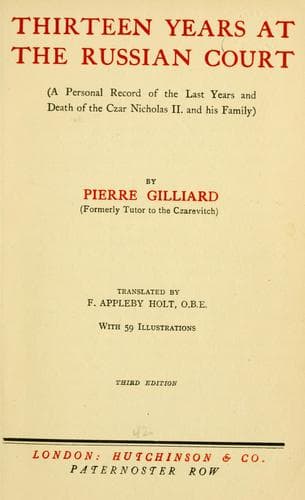
Thirteen years at the Russian court: (a personal record of the last years and death of the Czar Nicholas II. and his family)Gilliard, Pierre
History
Thirteen years at the Russian court: (a personal record of the last years and death of the Czar Nicholas II. and his family)
Gilliard, Pierre
Nicholas II, Emperor of Russia, 1868-1918; Romanov, House of; Soviet Union -- History -- Revolution, 1917-1921 -- Personal narratives
I am firmly convinced that the boundless love you bear our great
country is not dead within you. God bless you, and may St. George,
the great martyr, lead you to victory!
NICHOLAS.
_The Chief of the General Staff_, ALEXEIEFF.
In this sad and tragic hour the Czar had only one desire--to make the
task of the Government which had dethroned him easier. His only fear was
that the events which had happened might have an evil effect on the army
which the enemy could turn to his own advantage.
On the orders of the Minister of War this Order of the Day was never
brought to the knowledge of the troops!
* * * * *
Why did Fate decree that the Czar Nicholas II. should reign at the
beginning of the twentieth century and in one of the most troublous
periods of history? Endowed with remarkable personal qualities, he was
the incarnation of all that was noblest and most chivalrous in the
Russian nature. But he was weak. The soul of loyalty, he was the slave
of his pledged word. His fidelity to the Allies, which was probably the
cause of his death, proves it beyond doubt. He despised the methods of
diplomacy and he was not a fighter. He was crushed down by events.
Nicholas II. was modest and timid; he had not enough self-confidence:
hence all his misfortunes. His first impulse was usually right. The pity
was that he seldom acted on it because he could not trust himself. He
sought the counsel of those he thought more competent than himself; from
that moment he could no longer master the problems that faced him. They
escaped him. He hesitated between conflicting causes and often ended by
following that to which he was personally least sympathetic.
The Czarina knew the Czar’s irresolute character. As I have said, she
considered she had a sacred duty to help him in his heavy task. Her
influence on the Czar was very great and almost always unfortunate; she
made politics a matter of sentiment and personalities, and too often
allowed herself to be swayed by her sympathies or antipathies, or by
those of her _entourage_. Impulsive by nature, the Czarina was liable to
emotional outbursts which made her give her confidence unreservedly to
those she believed sincerely devoted to the country and the dynasty.
Protopopoff was a case in point.
Public-domain text, read in full here on John Shaqi.
Reviews
Reviews
No reviews yet
Be the first to share your thoughts on this work.
Elsewhere in the archive
Join the Discussion
Join the discussion
Sign in to leave a comment or review.
Sign InorCreate an account