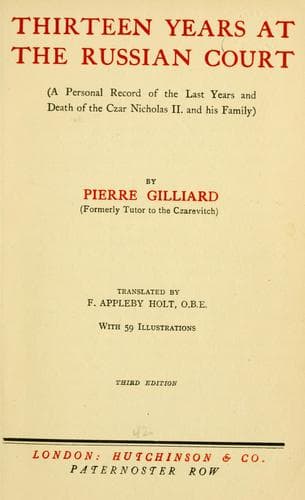
Thirteen years at the Russian court: (a personal record of the last years and death of the Czar Nicholas II. and his family)Gilliard, Pierre
History
Thirteen years at the Russian court: (a personal record of the last years and death of the Czar Nicholas II. and his family)
Gilliard, Pierre
Nicholas II, Emperor of Russia, 1868-1918; Romanov, House of; Soviet Union -- History -- Revolution, 1917-1921 -- Personal narratives
The Czar was always anxious to be just and to do the right thing. If he
sometimes failed, the fault lies at the door of those who did their
utmost to hide the truth from him and isolate him from his people. All
his generous impulses were broken against the passive resistance of an
omnipotent bureaucracy or were wilfully frustrated by those to whom he
entrusted their realisation. He thought that personal initiative,
however powerful and well meant, was nothing compared to those higher
forces which direct the course of events. Hence that sort of mystical
resignation in him which made him follow life rather than try to lead
it. It is one of the characteristics of the Russian nature.
An essentially reflective man, he would have been perfectly happy to
live as a private individual, but he was resigned to his lot, and humbly
accepted the superhuman task which God had given him. He loved his
people and his country with all the force of his nature; he had a
personal affection for the least of his subjects, those _moujiks_ whose
lot he earnestly desired to better.
What a tragic fate was that of this sovereign whose only desire during
his reign was to be close to his people and who never succeeded in
realising his wish. The fact is that he was well guarded, and by those
whose interest it was that he should not succeed.[57]
CHAPTER XVII
THE REVOLUTION SEEN FROM THE ALEXANDER PALACE--THE CZAR’S RETURN TO
TSARSKOÏE-SELO
While the dramatic events I have described in the preceding chapters
were in progress at Pskoff and Mohileff the Czarina and her children,
who had remained behind at the Alexander Palace, were passing through
days of the most poignant anguish.
As we have seen, it was only after long hesitation that the Czar, in his
anxiety, had decided on March 8th, 1917, to leave Tsarskoïe-Selo and go
to G.H.Q.
His departure was a great blow to the Czarina, for to the fears aroused
in her breast by the political situation had been added her anxiety
about Alexis Nicolaïevitch. The Czarevitch had been in bed with measles
for several days, and his condition had been aggravated by various
complications. To crown everything, three of the Grand-Duchesses had
also been taken ill, and there was no one but Marie Nicolaïevna to help
the mother.
On March 10th we learned that trouble had broken out in Petrograd and
that bloody collisions had taken place between police and demonstrators.
The fact was that for several days the shortage of food had produced
feelings of bitter discontent in the poorer quarters of the city. There
had been processions, and mobs had appeared in the streets demanding
bread.
I realised that Her Majesty had a good deal on her mind, for, contrary
to her usual habit, she spoke freely about political events, and told me
that Protopopoff had accused the Socialists of conducting an active
propaganda among railway employees with a view to preventing the
provisioning of the city, and thus precipitating a revolution.
Public-domain text, read in full here on John Shaqi.
Reviews
Reviews
No reviews yet
Be the first to share your thoughts on this work.
Elsewhere in the archive
Join the Discussion
Join the discussion
Sign in to leave a comment or review.
Sign InorCreate an account