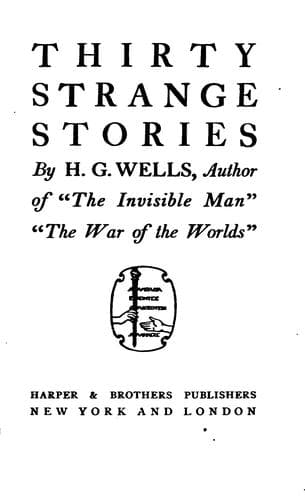
Thirty Strange StoriesWells, H. G. (Herbert George)
Science
Thirty Strange Stories
Wells, H. G. (Herbert George)
Fantasy fiction, English; Science fiction, English; Short stories, English
Temple came in first, his brown face flushed with drink, his coat
unbuttoned, his hands deep in his trousers’ pockets. His Christmas
resolution had long since dissolved in alcohol. He was a little puzzled
to find himself in Findlay’s company. And his fuddled brain insisted
upon inopportune reminiscence. He walked straight to the fire and stood
before it, an exaggerated black figure, staring down into the red glow.
“After all,” he said, “we are fools to quarrel—fools to quarrel about a
little thing like that. Damned fools!”
Findlay went to the writing-table and felt about for the matches with
quivering hands.
“It wasn’t my doing,” he said.
“It wasn’t your doing,” said Temple. “Nothing ever was your doing. You
are always in the right—Findlay the all-right.”
Findlay’s attention was concentrated upon the lamp. His hand was
unsteady, and he had some difficulty in turning up the wicks; one got
jammed down and the other flared furiously. When at last it was lit and
turned up, he came up to Temple. “Take your coat off, old man, and have
some more whiskey,” he said. “That was a ripping little girl in the
skirt dance.”
“Fools to quarrel,” said Temple, slowly, and then woke up to Findlay’s
words. “Heigh?”
“Take off your coat and sit down,” said Findlay, moving up the little
metal table and producing cigars and a syphon and whiskey. “That lamp
gives an infernally bad light, but it is all I have. Something wrong
with the oil. Did you notice the drudge of that stone-smashing trick?”
Temple remained erect and gloomy, staring into the fire. “Fools to
quarrel,” he said. Findlay was now half drunk, and his finesse began to
leave him. Temple had been drinking heavily, and was now in a curious
rambling stage. And Findlay’s one idea now was to close this curious
reunion.
“There’s no woman worth a man’s friendship,” said Temple, abruptly.
He sat down in an easy chair, poured out and drank a dose of whiskey and
lithia. The idea of friendship took possession of him, and he became
reminiscent of student days and student adventures. For some time it
was, “Do you remember” this, and “Do you remember” that. And Findlay
grew cheerful again.
“They were glorious times,” said Findlay, pouring whiskey into Temple’s
glass.
Then Temple startled him by abruptly reverting to that bitter quarrel.
“No woman in the world,” he said. “Curse them!”
He began to laugh stupidly. “After all—” he said, “in the end.”
“Oh, damn!” said Findlay.
“All very well for you to swear,” said Temple, “but you forget about me.
’Tain’t your place to swear. If only you’d left things alone—”
“I thought the pass-word was forget,” said Findlay.
Temple stared into the fire for a space, “Forget,” he said, and then
with a curious return to a clarity of speech, “Findlay, I’m getting
drunk.”
“Nonsense, man, take some more.”
Temple rose out of his chair with the look of one awakening. “There’s no
reason why I should get drunk, because—”
“Drink,” said Findlay, “and forget it.”
Public-domain text, read in full here on John Shaqi.
Reviews
Reviews
No reviews yet
Be the first to share your thoughts on this work.
Elsewhere in the archive
Join the Discussion
Join the discussion
Sign in to leave a comment or review.
Sign InorCreate an account