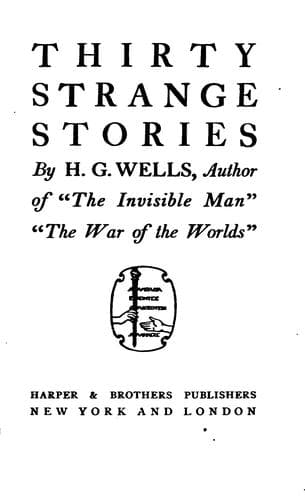
Thirty Strange StoriesWells, H. G. (Herbert George)
Science
Thirty Strange Stories
Wells, H. G. (Herbert George)
Fantasy fiction, English; Science fiction, English; Short stories, English
“_My_ father is a cobbler,” said Hill, quite irrelevantly, and perceived
the want of dignity even as he said it. But the gleam of jealousy did
not offend her. She conceived herself the fundamental source of it. He
suffered bitterly from a sense of Wedderburn’s unfairness and a
realisation of his own handicap. Here was this Wedderburn had picked up
a prominent man for a father, and instead of his losing so many marks on
the score of that advantage, it was counted to him for righteousness!
And while Hill had to introduce himself and talk to Miss Haysman
clumsily over mangled guinea-pigs in the laboratory, this Wedderburn, in
some backstairs way, had access to her social altitudes, and could
converse in a polished argot that Hill understood perhaps, but felt
incapable of speaking. Not of course that he wanted to. Then it seemed
to Hill that for Wedderburn to come there day after day with cuffs
unfrayed, neatly tailored, precisely barbered, quietly perfect, was in
itself an ill-bred, sneering sort of proceeding. Moreover, it was a
stealthy thing for Wedderburn to behave insignificantly for a space, to
mock modesty, to lead Hill to fancy that he himself was beyond dispute
the man of the year, and then suddenly to dart in front of him, and
incontinently to swell up in this fashion. In addition to these things
Wedderburn displayed an increasing disposition to join in any
conversational grouping that included Miss Haysman, and would venture,
and indeed seek occasion to pass opinions derogatory to Socialism and
Atheism. He goaded Hill to incivilities by neat, shallow, and
exceedingly effective personalities about the socialist leaders, until
Hill hated Bernard Shaw’s graceful egotisms, William Morris’s limited
editions and luxurious wall-papers, and Walter Crane’s charmingly absurd
ideal working-men, about as much as he hated Wedderburn. The
dissertations in the laboratory that had been his glory in the previous
term, became a danger, degenerated into inglorious tussles with
Wedderburn, and Hill kept to them only out of an obscure perception that
his honour was involved. In the Debating Society Hill knew quite clearly
that, to a thunderous accompaniment of banged desks, he could have
pulverised Wedderburn. Only Wedderburn never attended the Debating
Society to be pulverised, because—nauseous affectation!—he “dined late.”
Public-domain text, read in full here on John Shaqi.
Reviews
Reviews
No reviews yet
Be the first to share your thoughts on this work.
Elsewhere in the archive
Join the Discussion
Join the discussion
Sign in to leave a comment or review.
Sign InorCreate an account