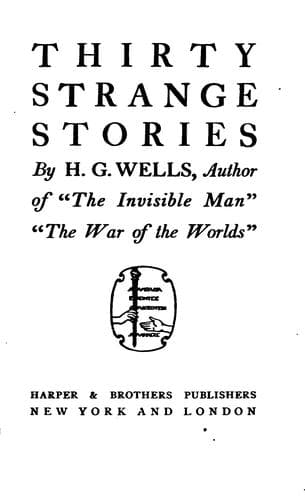
Thirty Strange StoriesWells, H. G. (Herbert George)
Science
Thirty Strange Stories
Wells, H. G. (Herbert George)
Fantasy fiction, English; Science fiction, English; Short stories, English
You must not imagine that these things presented themselves in quite
such a crude form to Hill’s perception. Hill was a born generaliser.
Wedderburn to him was not so much an individual obstacle as a type, the
salient angle of a class. The economic theories that, after infinite
ferment, had shaped themselves in Hill’s mind, became abruptly concrete
at the contact. The world became full of easy-mannered, graceful,
gracefully dressed, conversationally dexterous, finally shallow
Wedderburns, Bishops Wedderburn, Wedderburns, M.P., Professors
Wedderburn, Wedderburn landlords, all with finger-bowl shibboleths and
epigrammatic cities of refuge from a sturdy debater. And every one ill
clothed or ill dressed, from the cobbler to the cab runner, was a man
and a brother, a fellow-sufferer, to Hill’s imagination. So that he
became, as it were, a champion of the fallen and oppressed, albeit to
outward seeming only a self-assertive, ill-mannered young man, and an
unsuccessful champion at that. Again and again, a skirmish over the
afternoon tea that the girl-students had inaugurated, left Hill with
flushed cheeks and a tattered temper, and the Debating Society noticed a
new quality of sarcastic bitterness in his speeches.
You will understand now how it was necessary, if only in the interests
of humanity, that Hill should demolish Wedderburn in the forthcoming
examination and outshine him in the eyes of Miss Haysman, and you will
perceive, too, how Miss Haysman fell into some common feminine
misconceptions. The Hill-Wedderburn quarrel, for in his unostentatious
way Wedderburn reciprocated Hill’s ill-veiled rivalry, became a tribute
to her indefinable charm. She was the Queen of Beauty in a tournament of
scalpels and stumpy pencils. To her confidential friend’s secret
annoyance, it even troubled her conscience, for she was a good girl, and
painfully aware, from Ruskin and contemporary fiction, how entirely
men’s activities are determined by women’s attitudes. And if Hill never
by any chance mentioned the topic of love to her, she only credited him
with the finer modesty for that omission.
Public-domain text, read in full here on John Shaqi.
Reviews
Reviews
No reviews yet
Be the first to share your thoughts on this work.
Elsewhere in the archive
Join the Discussion
Join the discussion
Sign in to leave a comment or review.
Sign InorCreate an account