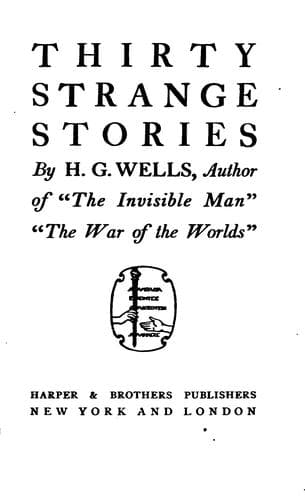
Thirty Strange StoriesWells, H. G. (Herbert George)
Science
Thirty Strange Stories
Wells, H. G. (Herbert George)
Fantasy fiction, English; Science fiction, English; Short stories, English
Presently he was carrying in the shutters, and in the briskest way; the
fire in the kitchen was crackling exhilaratingly with a little saucepan
walloping above it, for Minnie was boiling two eggs—one for herself this
morning, as well as one for him—and Minnie herself was audible, laying
breakfast with the greatest _éclat_. The blow was a sudden and terrible
one—but it behoves us to face such things bravely in this sad,
unaccountable world. It was quite midday before either of them mentioned
the cottages.
LE MARI TERRIBLE
“You are always so sympathetic,” she said; and added, reflectively, “and
one can talk of one’s troubles to you without any nonsense.”
I wondered dimly if she meant that as a challenge. I helped myself to a
biscuit thing that looked neither poisonous nor sandy. “You are one of
the most puzzling human beings I ever met,” I said,—a perfectly safe
remark to any woman under any circumstances.
“Do you find me so hard to understand?” she said.
“You are dreadfully complex.” I bit at the biscuit thing, and found it
full of a kind of creamy bird-lime. (I wonder why women _will_ arrange
these unpleasant surprises for me—I sickened of sweets twenty years
ago.)
“How so?” she was saying, and smiling her most brilliant smile.
I have no doubt she thought we were talking rather nicely. “Oh!” said I,
and waved the cream biscuit thing. “You challenge me to dissect you.”
“Well?”
“And that is precisely what I cannot do.”
“I’m afraid you are very satirical,” she said, with a touch of
disappointment. She is always saying that when our conversation has
become absolutely idiotic—as it invariably does. I felt an inevitable
desire to quote bogus Latin to her. It seemed the very language for her.
“Malorum fiducia pars quosque libet,” I said, in a low voice, looking
meaningly into her eyes.
“Ah!” she said, colouring a little, and turned to pour hot water into
the teapot, looking very prettily at me over her arm as she did so.
“That is one of the truest things that has ever been said of sympathy,”
I remarked. “Don’t you think so?”
“Sympathy,” she said, “is a very wonderful thing, and a very precious
thing.”
“You speak,” said I (with a cough behind my hand), “as though you knew
what it was to be lonely.”
“There is solitude even in a crowd,” she said, and looked round at the
six other people—three discreet pairs—who were in the room.
“I, too,” I was beginning, but Hopdangle came with a teacup, and seemed
inclined to linger. He belongs to the “Nice Boy” class, and gives
himself ridiculous airs of familiarity with grown-up people. Then the
Giffens went.
“Do you know, I always take such an interest in your work,” she was
saying to me, when her husband(confound him!) came into the room.
He was a violent discord. He wore a short brown jacket and carpet
slippers, and three of his waistcoat buttons were (as usual) undone.
“Got any tea left, Millie?” he said, and came and sat down in the
arm-chair beside the table.
Public-domain text, read in full here on John Shaqi.
Reviews
Reviews
No reviews yet
Be the first to share your thoughts on this work.
Elsewhere in the archive
Join the Discussion
Join the discussion
Sign in to leave a comment or review.
Sign InorCreate an account