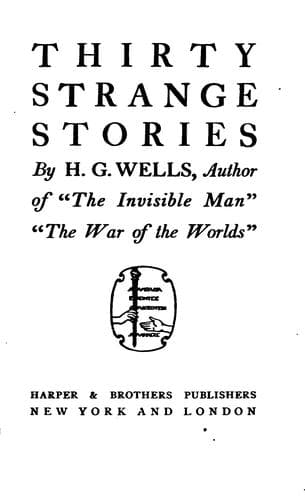
Thirty Strange StoriesWells, H. G. (Herbert George)
Science
Thirty Strange Stories
Wells, H. G. (Herbert George)
Fantasy fiction, English; Science fiction, English; Short stories, English
In the morning his regret had passed, but afterwards it returned and
troubled him; never, however, when he was happy or busily occupied. At
last, one moonlight night about eleven, when all Holmwood was quiet, his
regrets returned with redoubled force, and therewith an impulse to
adventure. He slipped out of the house and over the playground wall,
went through the silent town to Station Lane, and climbed into the
orchard where he had thrown the fruit. But nothing was to be found of it
there among the dewy grass and the faint intangible globes of dandelion
down.
THE SAD STORY OF A DRAMATIC CRITIC
I was—you shall hear immediately why I am not now—Egbert Craddock
Cummins. The name remains. I am still (Heaven help me!) Dramatic Critic
to the “Fiery Cross.” What I shall be in a little while I do not know. I
write in great trouble and confusion of mind. I will do what I can to
make myself clear in the face of terrible difficulties. You must bear
with me a little. When a man is rapidly losing his own identity, he
naturally finds a difficulty in expressing himself. I will make it
perfectly plain in a minute, when once I get my grip upon the story. Let
me see—where _am_ I? I wish I knew. Ah, I have it! Dead self! Egbert
Craddock Cummins!
In the past I should have disliked writing anything quite so full of “I”
as this story must be. It is full of “I’s” before and behind, like the
beast in Revelation—the one with a head like a calf, I am afraid. But my
tastes have changed since I became a Dramatic Critic and studied the
masters—G.R.S., G.B.S., G.A.S., and the others. Everything has changed
since then. At least the story is about myself—so that there is some
excuse for me. And it is really not egotism, because, as I say, since
those days my identity has undergone an entire alteration.
That past!—I was—in those days—rather a nice fellow, rather shy—taste
for grey in my clothes, weedy little moustache, face “interesting,”
slight stutter which I had caught in early life from a schoolfellow.
Engaged to a very nice girl, named Delia. Fairly new, she
was—cigarettes—liked me because I was human and original. Considered I
was like Lamb—on the strength of the stutter, I believe. Father, an
eminent authority on postage stamps. She read a great deal in the
British Museum. (A perfect pairing ground for literary people, that
British Museum—you should read George Egerton and Justin Huntly M’Carthy
and Gissing and the rest of them.) We loved in our intellectual way, and
shared the brightest hopes. (All gone now.) And her father liked me
because I seemed honestly eager to hear about stamps. She had no mother.
Indeed, I had the happiest prospects a young man could have. I never
went to the theatres in those days. My Aunt Charlotte before she died
had told me not to.
Public-domain text, read in full here on John Shaqi.
Reviews
Reviews
No reviews yet
Be the first to share your thoughts on this work.
Elsewhere in the archive
Join the Discussion
Join the discussion
Sign in to leave a comment or review.
Sign InorCreate an account