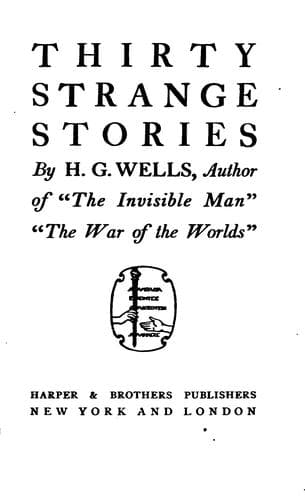
Thirty Strange StoriesWells, H. G. (Herbert George)
Science
Thirty Strange Stories
Wells, H. G. (Herbert George)
Fantasy fiction, English; Science fiction, English; Short stories, English
“The governess here,” said Aubrey Vair, “is robbing that child of its
youth in a terrible way. What will a life be that has no childhood at
the beginning?
“Some human beings are never young,” he continued, “and they never grow
up. They lead absolutely colourless lives. They are—they are etiolated.
They never love, and never feel the loss of it. They are—for the moment
I can think of no better image—they are human flowerpots, in which no
soul has been planted. But a human soul properly growing must begin in a
fresh childishness.”
“Yes,” said the dark lady, thoughtfully, “a careless childhood, running
wild almost. That should be the beginning.”
“Then we pass through the wonder and diffidence of youth.”
“To strength and action,” said the dark lady. Her dreamy eyes were fixed
on the Downs, and her fingers tightened on her knees as she spoke. “Ah,
it is a grand thing to live—as a man does—self-reliant and free.”
“And so at last,” said Aubrey Vair, “come to the culmination and crown
of life.” He paused and glanced hastily at her. Then he dropped his
voice almost to a whisper—“And the culmination of life is love.”
Their eyes met for a moment, but she looked away at once. Aubrey Vair
felt a peculiar thrill and a catching in his breath, but his emotions
were too complex for analysis. He had a certain sense of surprise, also,
at the way his conversation had developed.
Mrs. Bayne’s deaf aunt suddenly dug him in the chest with her
ear-trumpet, and some one at tennis bawled, “Love all!”
“Did I tell you Jane’s girls have had scarlet fever?” asked Mrs. Bayne’s
deaf aunt.
“No,” said Aubrey Vair.
“Yes; and they are peeling now,” said Mrs. Bayne’s deaf aunt, shutting
her lips tightly, and nodding in a slow, significant manner at both of
them.
There was a pause. All three seemed lost in thought, too deep for words.
“Love,” began Aubrey Vair, presently, in a severely philosophical tone,
leaning back in his chair, holding his hands like a praying saint’s in
front of him, and staring at the toe of his shoe,—“love is, I believe,
the one true and real thing in life. It rises above reason, interest, or
explanation. Yet I never read of an age when it was so much forgotten as
it is now. Never was love expected to run so much in appointed channels,
never was it so despised, checked, ordered, and obstructed. Policemen
say, ‘This way, Eros!’ As a result, we relieve our emotional
possibilities in the hunt for gold and notoriety. And after all, with
the best fortune in these, we only hold up the gilded images of our
success, and are weary slaves, with unsatisfied hearts, in the pageant
of life.”
Aubrey Vair sighed, and there was a pause. The girl looked at him out of
the mysterious darkness of her eyes. She had read many books, but Aubrey
Vair was her first literary man, and she took this kind of thing for
genius—as girls have done before.
Public-domain text, read in full here on John Shaqi.
Reviews
Reviews
No reviews yet
Be the first to share your thoughts on this work.
Elsewhere in the archive
Join the Discussion
Join the discussion
Sign in to leave a comment or review.
Sign InorCreate an account