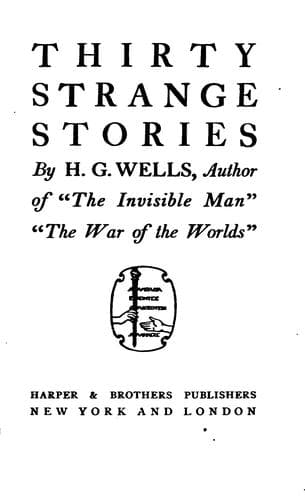
Thirty Strange StoriesWells, H. G. (Herbert George)
Science
Thirty Strange Stories
Wells, H. G. (Herbert George)
Fantasy fiction, English; Science fiction, English; Short stories, English
“We are,” continued Aubrey Vair, conscious of a favourable
impression,—“we are like fireworks, mere dead, inert things until the
appointed spark comes; and then—if it is not damp—the dormant soul
blazes forth in all its warmth and beauty. That is living. I sometimes
think, do you know, that we should be happier if we could die soon after
that golden time, like the Ephemerides. There is a decay sets in.”
“Eigh?” said Mrs. Bayne’s deaf aunt, startlingly. “I didn’t hear you.”
“I was on the point of remarking,” shouted Aubrey Vair, wheeling the
array of his thoughts,—“I was on the point of remarking that few people
in Redhill could match Mrs. Morton’s fine broad green.”
“Others have noticed it,” Mrs. Bayne’s deaf aunt shouted back. “It is
since she has had in her new false teeth.”
This interruption dislocated the conversation a little. However—
“I must thank you, Mr. Vair,” said the dark girl, when they parted that
afternoon, “for having given me very much to think about.”
And from her manner, Aubrey Vair perceived clearly he had not wasted his
time.
It would require a subtler pen than mine to tell how from that day a
passion for Miss Smith grew like Jonah’s gourd in the heart of Aubrey
Vair. He became pensive, and in the prolonged absence of Miss Smith,
irritable. Mrs. Aubrey Vair felt the change in him, and put it down to a
vitriolic Saturday Reviewer. Indisputably the “Saturday” does at times
go a little far. He re-read “Elective Affinities,” and lent it to Miss
Smith. Incredible as it may appear to members of the Areopagus Club,
where we know Aubrey Vair, he did also beyond all question inspire a
sort of passion in that sombre-eyed, rather clever, and really very
beautiful girl.
He talked to her a lot about love and destiny, and all that bric-à-brac
of the minor poet. And they talked together about his genius. He
elaborately, though discreetly, sought her society, and presented and
read to her the milder of his unpublished sonnets. We consider his
Byronic features pasty, but the feminine mind has its own laws. I
suppose, also, where a girl is not a fool, a literary man has an
enormous advantage over any one but a preacher, in the show he can make
of his heart’s wares.
At last a day in that summer came when he met her alone, possibly by
chance, in a quiet lane towards Horley. There were ample hedges on
either side, rich with honeysuckle, vetch, and mullein.
They conversed intimately of his poetic ambitions, and then he read her
those verses of his subsequently published in “Hobson’s Magazine:”
“Tenderly ever, since I have met thee.” He had written these the day
before; and though I think the sentiment is uncommonly trite, there is a
redeeming note of sincerity about the lines not conspicuous in all
Aubrey Vair’s poetry.
Public-domain text, read in full here on John Shaqi.
Reviews
Reviews
No reviews yet
Be the first to share your thoughts on this work.
Elsewhere in the archive
Join the Discussion
Join the discussion
Sign in to leave a comment or review.
Sign InorCreate an account