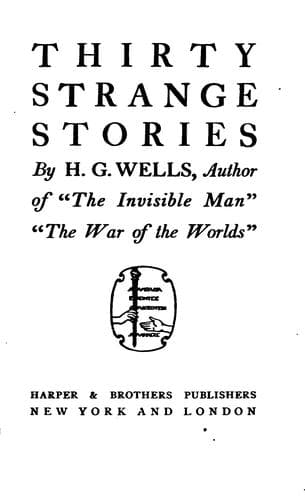
Thirty Strange StoriesWells, H. G. (Herbert George)
Science
Thirty Strange Stories
Wells, H. G. (Herbert George)
Fantasy fiction, English; Science fiction, English; Short stories, English
“Possibly it is a sexual difference,” said Aubrey Vair; and then,
feeling the remark inadequate, he relapsed into silence.
They sat for some time without a word. The two lights in Reigate below
multiplied to a score of bright points, and, above, one star had become
visible. She began laughing, an almost noiseless, hysterical laugh that
jarred unaccountably upon Aubrey Vair.
Presently she stood up. “They will wonder where I am,” she said. “I
think I must be going.”
He followed her to the road. “Then this is the end?” he said, with a
curious mixture of relief and poignant regret.
“Yes, this is the end,” she answered, and turned away.
There straightway dropped into the soul of Aubrey Vair a sense of
infinite loss. It was an altogether new sensation. She was perhaps
twenty yards away, when he groaned aloud with the weight of it, and
suddenly began running after her with his arms extended.
“Annie,” he cried,—“Annie! I have been talking _rot_. Annie, now I know
I love you! I cannot spare you. This must not be. I did not understand.”
The weight was horrible.
“Oh, stop, Annie!” he cried, with a breaking voice, and there were tears
on his face.
She turned upon him suddenly, with a look of annoyance, and his arms
fell by his side. His expression changed at the sight of her pale face.
“You do not understand,” she said. “I have said good-bye.”
She looked at him; he was evidently greatly distressed, a little out of
breath, and he had just stopped blubbering. His contemptible quality
reached the pathetic. She came up close to him, and, taking his damp
Byronic visage between her hands, she kissed him again and again.
“Good-bye, little man that I loved,” she said; “and good-bye to this
folly of love.”
Then, with something that may have been a laugh or a sob,—she herself,
when she came to write it all in her novel, did not know which,—she
turned and hurried away again, and went out of the path that Aubrey Vair
must pursue, at the cross-roads.
Aubrey Vair stood, where she had kissed him, with a mind as inactive as
his body, until her white dress had disappeared. Then he gave an
involuntary sigh, a large, exhaustive expiration, and so awoke himself,
and began walking, pensively dragging his feet through the dead leaves,
home. Emotions are terrible things.
“Do you like the potatoes, dear?” asked Mrs. Aubrey Vair at dinner. “I
cooked them myself.”
Aubrey Vair descended slowly from cloudy, impalpable meditations to the
level of fried potatoes. “These potatoes—” he remarked, after a pause
during which he was struggling with recollection. “Yes. These potatoes
have exactly the tints of the dead leaves of the hazel.”
“What a fanciful poet it is!” said Mrs. Aubrey Vair. “Taste them. They
are very nice potatoes indeed.”
THE LORD OF THE DYNAMOS
Public-domain text, read in full here on John Shaqi.
Reviews
Reviews
No reviews yet
Be the first to share your thoughts on this work.
Elsewhere in the archive
Join the Discussion
Join the discussion
Sign in to leave a comment or review.
Sign InorCreate an account