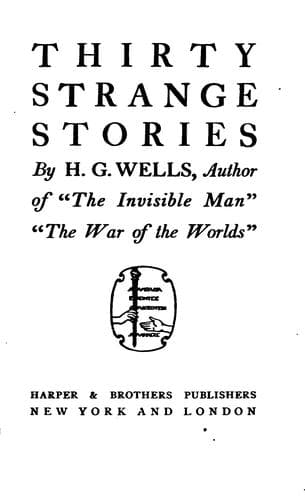
Thirty Strange StoriesWells, H. G. (Herbert George)
Science
Thirty Strange Stories
Wells, H. G. (Herbert George)
Fantasy fiction, English; Science fiction, English; Short stories, English
The summer passed at last into the harvest-time, and the leaves began
falling. It was evening, the warm sunset light still touched the Downs,
but up the valley a blue haze was creeping. One or two lamps in Reigate
were already alight.
About half-way up the slanting road that scales the Downs, there is a
wooden seat where one may obtain a fine view of the red villas scattered
below, and of the succession of blue hills beyond. Here the girl with
the shadowy face was sitting.
She had a book on her knees, but it lay neglected. She was leaning
forward, her chin resting upon her hand. She was looking across the
valley into the darkening sky, with troubled eyes.
Aubrey Vair appeared through the hazel-bushes, and sat down beside her.
He held half a dozen dead leaves in his hand.
She did not alter her attitude. “Well?” she said.
“Is it to be flight?” he asked.
Aubrey Vair was rather pale. He had been having bad nights latterly,
with dreams of the Continental Express Mrs. Aubrey Vair possibly even in
pursuit,—he always fancied her making the tragedy ridiculous by
tearfully bringing additional pairs of socks, and any such trifles he
had forgotten, with her,—all Reigate and Redhill in commotion. He had
never eloped before, and he had visions of difficulties with hotel
proprietors. Mrs. Aubrey Vair might telegraph ahead. Even he had had a
prophetic vision of a headline in a halfpenny evening newspaper: “Young
Lady abducts a Minor Poet.” So there was a quaver in his voice as he
asked, “Is it to be flight?”
“As you will,” she answered, still not looking at him.
“I want you to consider particularly how this will affect you. A man,”
said Aubrey Vair, slowly, and staring hard at the leaves in his hand,
“even gains a certain éclat in these affairs. But to a woman it is
ruin—social, moral.”
“This is not love,” said the girl in white.
“Ah, my dearest! Think of yourself.”
“Stupid!” she said, under her breath.
“You spoke?”
“Nothing.”
“But cannot we go on, meeting one another, loving one another, without
any great scandal or misery? Could we not—”
“That,” interrupted Miss Smith, “would be unspeakably horrible.”
“This is a dreadful conversation to me. Life is so intricate, such a web
of subtle strands binds us this way and that. I cannot tell what is
right. You must consider—”
“A man would break such strands.”
“There is no manliness,” said Aubrey Vair, with a sudden glow of moral
exaltation, “in doing wrong. My love—”
“We could at least die together, dearest,” she said discontentedly.
“Good Lord!” said Aubrey Vair. “I mean—consider my wife.”
“You have not considered her hitherto.”
“There is a flavour—of cowardice, of desertion, about suicide,” said
Aubrey Vair. “Frankly, I have the English prejudice, and do not like any
kind of running away.”
Miss Smith smiled very faintly. “I see clearly now what I did not see.
My love and yours are very different things.”
Public-domain text, read in full here on John Shaqi.
Reviews
Reviews
No reviews yet
Be the first to share your thoughts on this work.
Elsewhere in the archive
Join the Discussion
Join the discussion
Sign in to leave a comment or review.
Sign InorCreate an account