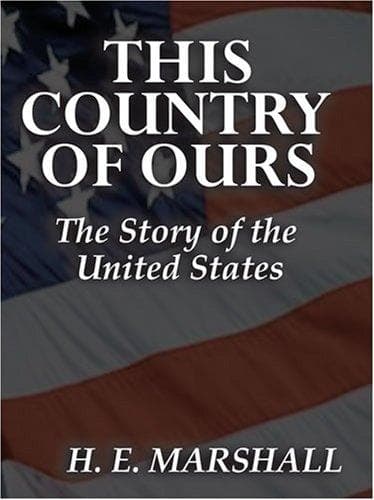
This Country of OursMarshall, H. E. (Henrietta Elizabeth)
History
This Country of Ours
Marshall, H. E. (Henrietta Elizabeth)
United States -- History
At length their efforts were rewarded and New Hampshire made the
ninth, and just four days later the great State of Virginia also
came in. New York soon followed and only North Carolina and Rhode
Island remained out of the Union. But in time they, too, came in,
Rhode Island last of all, and not for fully a year after the first
President had been chosen, and the government organised.
The new government required that there should be a Congress to look
after the affairs of the nation, with two houses, something after
the fashion of the British Parliament. It also required that there
should be a President at the head of everything.
There was little doubt as to who should fill that place. George
Washington, the man who had led the army to victory, was the man
chosen to be first President of the United States.
Other people were indeed voted for, but Washington had more than
twice as many votes as John Adams, who came next to him. The others
were simply nowhere. So Washington was made President and Adams
vice-president.
But Washington had no wish to be President. He was too old, he said
(he was only fifty-seven) and besides he was not even a statesman
but a soldier. The people, however, would not listen to him. "We
cannot do without you," they said. "There is no use framing a new
government if the best man is to be left out of it."
So to the entreaties of his friends Washington yielded. But it was
with a heavy heart, for he greatly doubted his own powers.
"In confidence I tell you," he wrote to an old friend, "that my
movement to the chair of government will be accompanied by feelings
not unlike those of a culprit who is going to the place of his
execution."
But whatever he felt, his journey to New York was not like that of
a criminal, but rather like that of a king. From far and near the
people crowded to see him pass. They raised triumphal arches, they
scattered flowers at his feet, they sang chants and hymns in his
honour. From first to last it was one long triumph. When he reached
New York bells rang and cannon boomed, the streets were gay with
flags, and crowded with people, and as he passed along cheer upon
cheer thundered and echoed over the city.
Next day, the 30th of April, 1789, Washington took his place as
President of the United States.
At nine o'clock in the morning the churches were thronged with
people praying for the welfare of their President. By twelve these
same people were all crowding to the Federal Hall eager to be
present at the great ceremony. Soon the space in front of the hall
was one closely packed mass of people; every window and balcony
was crowded also, and people were even to be seen on the roofs.
Public-domain text, read in full here on John Shaqi.
Reviews
Reviews
No reviews yet
Be the first to share your thoughts on this work.
Elsewhere in the archive
Join the Discussion
Join the discussion
Sign in to leave a comment or review.
Sign InorCreate an account