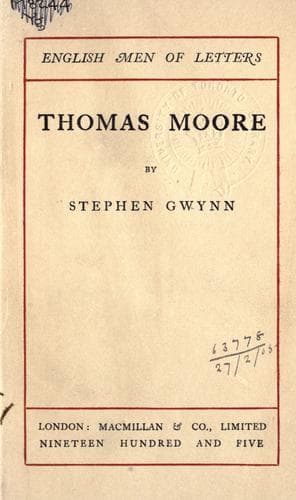
The purpose of this book is to give, if possible, a just estimate of the
man's character and of his work as a poet. The problem, so far as the
biographical part is concerned, is not to discover new material but to
select from masses already in print. The Memoirs of his Life, edited by
Lord John Russell, fill eight volumes, though the life with which they
deal was neither long nor specially eventful. In addition we have
allusions to Moore, as a widely known social personage, in almost every
memoir of that time; and newspaper references by thousands have been
collected. These extraneous sources, however, add very little to the
impression which is gained by a careful reading of the correspondence
and of the long diaries in which Moore's nature, singularly unsecretive,
displays itself with perfect frankness. Whether one's aim be to justify
Moore or to condemn him, the most effective means are provided by his
own words; and for nearly everything that I have to allege in the
narrative part of this work, Moore, himself is the authority. Nor is the
critical estimate which has to be put forward, though remote from that
of Moore's official biographer, at all unlike that which the poet
himself seems to have formed of his work.
Thomas Moore was born in Dublin on the 28th of May 1779, at No. 12
Aungier Street, where his father, a native of Kerry, kept a grocer's
shop. His mother, Anastasia Clodd, was the daughter of a small provision
merchant in Wexford. Moore was their eldest child, and of the brothers
and sisters whom he mentions, only two girls, his sisters Katherine and
Ellen, appear to have grown up or to have played any part in his life.
His parents were evidently prosperous people, devoted to their clever
boy and ambitious to secure him social promotion by giving scope to the
talents which he showed from his early schooldays. The memoir of his
youth, which Moore wrote in middle life, notes the special pleasure
which his mother took in the friendship of a certain Miss Dodd, an
elderly maiden lady moving in "a class of society somewhat of a higher
level than ours"; and it is easy enough to understand why the precocious
imp of a boy found favour with this distinguished person and her guests.
He had all the gifts of an actor and a mimic, and they were encouraged
in him first at home, and then at the boarding-school to which he was
sent. Samuel Whyte, its head master, had been the teacher of Sheridan,
and though he discovered none of Sheridan's abilities, the connection
with the Sheridan family, added to his own tastes, had brought him into
close touch with the stage. He was the author of a didactic poem on "The
Theatre," a great director of private theatricals, and a teacher of
elocution. Such a man was not likely to neglect the gifts of the clever
small boy entrusted to him, and Master Moore, at the age of eleven,
already figured on the playbill of some important private theatricals as
reciting the Epilogue.
Public-domain text, read in full here on John Shaqi.
Reviews
Reviews
No reviews yet
Be the first to share your thoughts on this work.
Join the Discussion
Join the discussion
Sign in to leave a comment or review.
Sign InorCreate an account