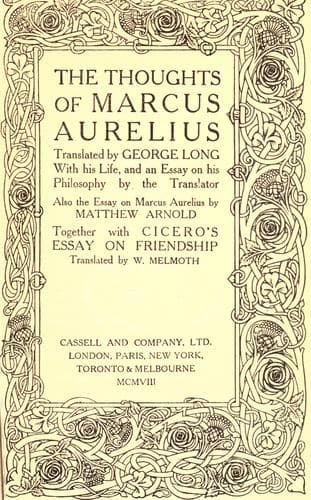
Thoughts of Marcus AureliusMarcus Aurelius, Emperor of Rome
PhilosophyPhilosophy
Thoughts of Marcus Aurelius
Marcus Aurelius, Emperor of Rome
Ethics; Life; Marcus Aurelius, Emperor of Rome, 121-180; Stoics
12. How quickly all things disappear,—in the universe the bodies
themselves, but in time the remembrance of them. What is the nature of
all sensible things, and particularly those which attract with the bait
of pleasure or terrify by pain, or are noised abroad by vapory fame;
how worthless, and contemptible, and sordid, and perishable, and dead
they are,—all this it is the part of the intellectual faculty to
observe. To observe too who these are whose opinions and voices give
reputation; what death is, and the fact that, if a man looks at it in
itself, and by the abstractive power of reflection resolves into their
parts all the things which present themselves to the imagination in it,
he will then consider it to be nothing else than an operation of
nature; and if any one is afraid of an operation of nature, he is a
child. This, however, is not only an operation of nature, but it is
also a thing which conduces to the purposes of nature. To observe too
how man comes near to the Deity, and by what part of him, and when this
part of man is so disposed (VI. 28).
13. Nothing is more wretched than a man who traverses everything in a
round, and pries into the things beneath the earth, as the poet says,
and seeks by conjecture what is in the minds of his neighbors, without
perceiving that it is sufficient to attend to the daemon within him,
and to reverence it sincerely. And reverence of the daemon consists in
keeping it pure from passion and thoughtlessness, and dissatisfaction
with what comes from gods and men. For the things from the gods merit
veneration for their excellence; and the things from men should be dear
to us by reason of kinship; and sometimes even, in a manner, they move
our pity by reason of men’s ignorance of good and bad; this defect
being not less than that which deprives us of the power of
distinguishing things that are white and black.
14. Though thou shouldest be going to live three thousand years, and as
many times ten thousand years, still remember that no man loses any
other life than this which he now lives, nor lives any other than this
which he now loses. The longest and shortest are thus brought to the
same. For the present is the same to all, though that which perishes is
not the same; and so that which is lost appears to be a mere moment.
For a man cannot lose either the past or the future: for what a man has
not, how can any one take this from him? These two things then thou
must bear in mind; the one, that all things from eternity are of like
forms and come round in a circle, and that it makes no difference
whether a man shall see the same things during a hundred years, or two
hundred, or an infinite time; and the second, that the longest liver
and he who will die soonest lose just the same. For the present is the
only thing of which a man can be deprived, if it is true that this is
the only thing which he has, and that a man cannot lose a thing if he
has it not.
Public-domain text, read in full here on John Shaqi.
Reviews
Reviews
No reviews yet
Be the first to share your thoughts on this work.
Join the Discussion
Join the discussion
Sign in to leave a comment or review.
Sign InorCreate an account