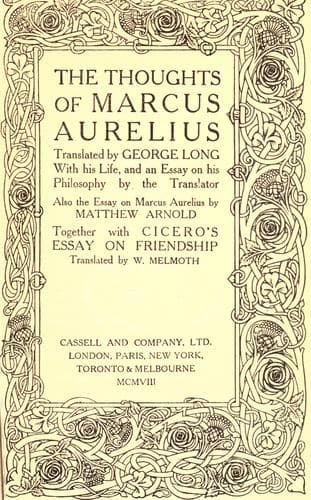
Thoughts of Marcus AureliusMarcus Aurelius, Emperor of Rome
PhilosophyPhilosophy
Thoughts of Marcus Aurelius
Marcus Aurelius, Emperor of Rome
Ethics; Life; Marcus Aurelius, Emperor of Rome, 121-180; Stoics
1. We ought to consider not only that our life is daily wasting away
and a smaller part of it is left, but another thing also must be taken
into the account, that if a man should live longer, it is quite
uncertain whether the understanding will still continue sufficient for
the comprehension of things, and retain the power of contemplation
which strives to acquire the knowledge of the divine and the human. For
if he shall begin to fall into dotage, perspiration and nutrition and
imagination and appetite, and whatever else there is of the kind, will
not fail; but the power of making use of ourselves, and filling up the
measure of our duty, and clearly separating all appearances, and
considering whether a man should now depart from life, and whatever
else of the kind absolutely requires a disciplined reason,—all this is
already extinguished. We must make haste, then, not only because we are
daily nearer to death, but also because the conception of things and
the understanding of them cease first.
2. We ought to observe also that even the things which follow after the
things which are produced according to nature contain something
pleasing and attractive. For instance, when bread is baked some parts
are split at the surface, and these parts which thus open, and have a
certain fashion contrary to the purpose of the baker’s art, are
beautiful in a manner, and in a peculiar way excite a desire for
eating. And again, figs, when they are quite ripe, gape open; and in
the ripe olives the very circumstance of their being near to rottenness
adds a peculiar beauty to the fruit. And the ears of corn bending down,
and the lion’s eyebrows, and the foam which flows from the mouth of
wild boars, and many other things,—though they are far from being
beautiful if a man should examine them severally,—still, because they
are consequent upon the things which are formed by nature, help to
adorn them, and they please the mind; so that if a man should have a
feeling and deeper insight with respect to the things which are
produced in the universe, there is hardly one of those which follow by
way of consequence which will not seem to him to be in a manner
disposed so as to give pleasure. And so he will see even the real
gaping jaws of wild beasts with no less pleasure than those which
painters and sculptors show by imitation; and in an old woman and an
old man he will be able to see a certain maturity and comeliness; and
the attractive loveliness of young persons he will be able to look on
with chaste eyes; and many such things will present themselves, not
pleasing to every man, but to him only who has become truly familiar
with Nature and her works.
Public-domain text, read in full here on John Shaqi.
Reviews
Reviews
No reviews yet
Be the first to share your thoughts on this work.
Join the Discussion
Join the discussion
Sign in to leave a comment or review.
Sign InorCreate an account