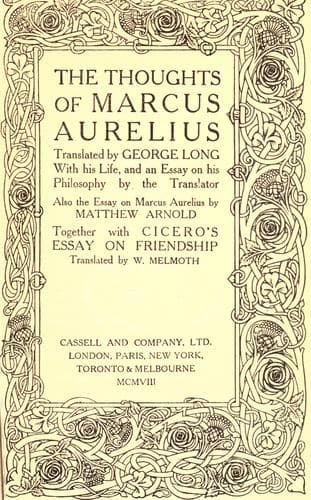
Thoughts of Marcus AureliusMarcus Aurelius, Emperor of Rome
PhilosophyPhilosophy
Thoughts of Marcus Aurelius
Marcus Aurelius, Emperor of Rome
Ethics; Life; Marcus Aurelius, Emperor of Rome, 121-180; Stoics
When he was eleven years old he assumed the dress of philosophers,
something plain and coarse, became a hard student, and lived a most
laborious, abstemious life, even so far as to injure his health. He
abandoned poetry and rhetoric for philosophy, and attached himself to
the sect of the Stoics. But he did not neglect the study of law, which
was a useful preparation for the high place which he was designed to
fill. We must suppose that he learned the Roman discipline of arms,
which was a necessary part of the education of a man who afterwards led
his troops to battle against a warlike race.
Antoninus has recorded in his first book the names of his teachers, and
the obligations which he owed to each of them. The way in which he
speaks of what he learned from them might seem to savor of vanity or
self- praise, if we look carelessly at the way in which he has
expressed himself; but if anyone draws this conclusion, he will be
mistaken. Antoninus means to commemorate the merits of his several
teachers, what they taught, and what a pupil might learn from them.
Besides, this book, like the eleven other books, was for his own use;
and if we may trust the note at the end of the first book, it was
written during one of M. Antoninus’ campaigns against the Quadi, at a
time when the commemoration of the virtues of his illustrious teachers
might remind him of their lessons and the practical uses which he might
derive from them.
Among his teachers of philosophy was Sextus of Chaeroneia, a grandson
of Plutarch. What he learned from this excellent man is told by himself
(I. 9). His favorite teacher was Rusticus (I. 7), a philosopher, and
also a man of practical good sense in public affairs. Rusticus was the
adviser of Antoninus after he became emperor. Young men who are
destined for high places are not often fortunate in those who are about
them, their companions and teachers; and I do not know any example of a
young prince having had an education which can be compared with that of
M. Antoninus. Such a body of teachers distinguished by their
acquirements and their character will hardly be collected again; and as
to the pupil, we have not had one like him since.
Hadrian died in July, A.D. 138, and was succeeded by Antoninus Pius. M.
Antoninus married Faustina, his cousin, the daughter of Pius, probably
about A.D. 146, for he had a daughter born in A.D. 147. He received
from his adoptive father the title of Caesar, and was associated with
him in the administration of the state. The father and the adopted son
lived together in perfect friendship and confidence. Antoninus was a
dutiful son, and the emperor Pius loved and esteemed him.
Public-domain text, read in full here on John Shaqi.
Reviews
Reviews
No reviews yet
Be the first to share your thoughts on this work.
Join the Discussion
Join the discussion
Sign in to leave a comment or review.
Sign InorCreate an account