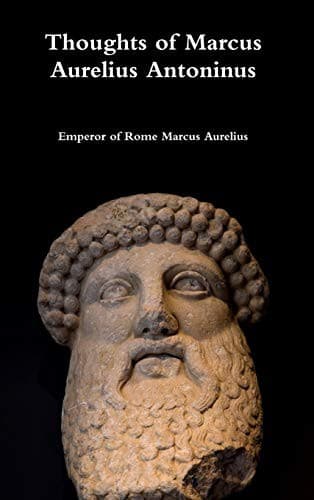
Thoughts of Marcus Aurelius Antoninus — John Shaqi
Thoughts of Marcus Aurelius AntoninusMarcus Aurelius, Emperor of Rome
PhilosophyPhilosophy
Thoughts of Marcus Aurelius Antoninus
Marcus Aurelius, Emperor of Rome
Ethics; Life; Marcus Aurelius, Emperor of Rome, 121-180; Stoics
Produced by Juliet Sutherland, Turgut Dincer, Leonard
Johnson and the Online Distributed Proofreading Team at
https://www.pgdp.net.
THE THOUGHTS
OF
THE EMPEROR
MARCUS AURELIUS ANTONINUS
[Illustration: MARCUS AURELIUS ANTONINUS]
CONTENTS.
BIOGRAPHICAL SKETCH 9
PHILOSOPHY OF MARCUS AURELIUS ANTONINUS 45
THE THOUGHTS 99
INDEX OF TERMS 305
GENERAL INDEX 311
BIOGRAPHICAL SKETCH
OF
MARCUS AURELIUS ANTONINUS.
M. Antoninus was born at Rome, A.D. 121, on the 26th of April. His
father, Annius Verus, died while he was praetor. His mother was Domitia
Calvilla, also named Lucilla. The Emperor T. Antoninus Pius married
Annia Galeria Faustina, the sister of Annius Verus, and was consequently
the uncle of M. Antoninus. When Hadrian adopted Antoninus Pius and
declared him his successor in the empire, Antoninus Pius adopted both L.
Ceionius Commodus, the son of Aelius Caesar, and M. Antoninus, whose
original name was M. Annius Verus. Antoninus then took the name of M.
Aelius Aurelius Verus, to which was added the title of Caesar in A.D.
139: the name Aelius belonged to Hadrian's family, and Aurelius was the
name of Antoninus Pius. When M. Antoninus became Augustus, he dropped
the name of Verus and took the name of Antoninus. Accordingly he is
generally named M. Aurelius Antoninus, or simply M. Antoninus.
The youth was most carefully brought up. He thanks the gods (i. 17) that
he had good grandfathers, good parents, a good sister, good teachers,
good associates, good kinsmen and friends, nearly everything good. He
had the happy fortune to witness the example of his uncle and adoptive
father Antoninus Pius, and he has recorded in his word (i. 16; vi. 30)
the virtues of the excellent man and prudent ruler. Like many young
Romans he tried his hand at poetry and studied rhetoric. Herodes Atticus
and M. Cornelius Fronto were his teachers in eloquence. There are extant
letters between Fronto and Marcus,[A] which show the great affection of
the pupil for the master, and the master's great hopes of his
industrious pupil. M. Antoninus mentions Fronto (i. 11) among those to
whom he was indebted for his education.
[A] M. Cornelii Frontonis Reliquiae, Berlin, 1816. There are a
few letters between Fronto and Antoninus Pius.
When he was eleven years old, he assumed the dress of philosophers,
something plain and coarse, became a hard student, and lived a most
laborious, abstemious life, even so far as to injure his health.
Finally, he abandoned poetry and rhetoric for philosophy, and he
attached himself to the sect of the Stoics. But he did not neglect the
study of law, which was a useful preparation for the high place which he
was designed to fill. His teacher was L. Volusianus Maecianus, a
distinguished jurist. We must suppose that he learned the Roman
discipline of arms, which was a necessary part of the education of a man
who afterwards led his troops to battle against a warlike race.
Public-domain text, read in full here on John Shaqi.
Reviews
Reviews
No reviews yet
Be the first to share your thoughts on this work.
Join the Discussion
Join the discussion
Sign in to leave a comment or review.
Sign InorCreate an account