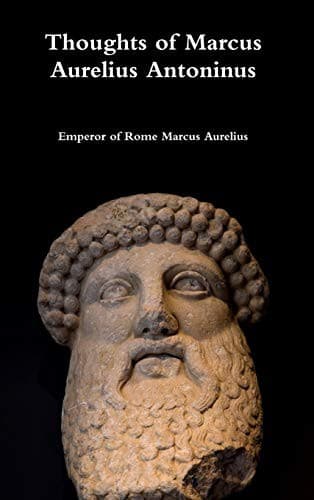
Thoughts of Marcus Aurelius AntoninusMarcus Aurelius, Emperor of Rome
PhilosophyPhilosophy
Thoughts of Marcus Aurelius Antoninus
Marcus Aurelius, Emperor of Rome
Ethics; Life; Marcus Aurelius, Emperor of Rome, 121-180; Stoics
54. No longer let thy breathing only act in concert with the air which
surrounds thee, but let thy intelligence also now be in harmony with the
intelligence which embraces all things. For the intelligent power is no
less diffused in all parts and pervades all things for him who is
willing to draw it to him than the aerial power for him who is able to
respire it.
55. Generally, wickedness does no harm at all to the universe; and
particularly the wickedness [of one man] does no harm to another. It is
only harmful to him who has it in his power to be released from it as
soon as he shall choose.
56. To my own free will the free will of my neighbor is just as
indifferent as his poor breath and flesh. For though we are made
especially for the sake of one another, still the ruling power of each
of us has its own office, for otherwise my neighbor's wickedness would
be my harm, which God has not willed, in order that my unhappiness may
not depend on another.
57. The sun appears to be poured down, and in all directions indeed it
is diffused, yet it is not effused. For this diffusion is extension:
Accordingly its rays are called Extensions [[Greek: aktines]] because
they are extended [[Greek: apo tou ekteinesthai]].[A] But one may judge
what kind of a thing a ray is, if he looks at the sun's light passing
through a narrow opening into a darkened room, for it is extended in a
right line, and as it were is divided when it meets with any solid body
which stands in the way and intercepts the air beyond; but there the
light remains fixed and does not glide or fall off. Such then ought to
be the outpouring and diffusion of the understanding, and it should in
no way be an effusion, but an extension, and it should make no violent
or impetuous collision with the obstacles which are in its way; nor yet
fall down, but be fixed, and enlighten that which receives it. For a
body will deprive itself of the illumination, if it does not admit it.
[A] A piece of bad etymology.
58. He who fears death either fears the loss of sensation or a different
kind of sensation. But if thou shalt have no sensation, neither wilt
thou feel any harm; and if thou shalt acquire another kind of sensation,
thou wilt be a different kind of living being and thou wilt not cease to
live.
59. Men exist for the sake of one another. Teach them then, or bear with
them.
60. In one way an arrow moves, in another way the mind. The mind indeed,
both when it exercises caution and when it is employed about inquiry,
moves straight onward not the less, and to its object.
61. Enter into every man's ruling faculty; and also let every other man
enter into thine.[A]
[A] Compare Epictetus, iii. 9, 12.
IX.
Public-domain text, read in full here on John Shaqi.
Reviews
Reviews
No reviews yet
Be the first to share your thoughts on this work.
Elsewhere in the archive
Join the Discussion
Join the discussion
Sign in to leave a comment or review.
Sign InorCreate an account