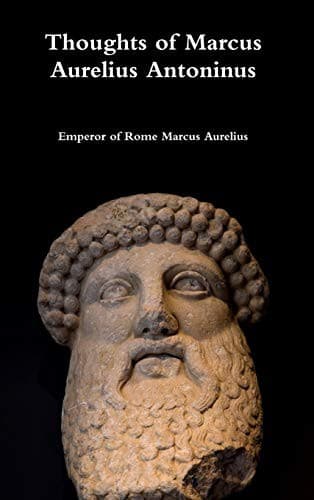
Thoughts of Marcus Aurelius AntoninusMarcus Aurelius, Emperor of Rome
PhilosophyPhilosophy
Thoughts of Marcus Aurelius Antoninus
Marcus Aurelius, Emperor of Rome
Ethics; Life; Marcus Aurelius, Emperor of Rome, 121-180; Stoics
6. Whether the universe is [a concourse of] atoms, or nature [is a
system], let this first be established, that I am a part of the whole
which is governed by nature; next, I am in a manner intimately related
to the parts which are of the same kind with myself. For remembering
this, inasmuch as I am a part, I shall be discontented with none of the
things which are assigned to me out of the whole; for nothing is
injurious to the part if it is for the advantage of the whole. For the
whole contains nothing which is not for its advantage; and all natures
indeed have this common principle, but the nature of the universe has
this principle besides, that it cannot be compelled even by any external
cause to generate anything harmful to itself. By remembering, then, that
I am a part of such a whole, I shall be content with everything that
happens. And inasmuch as I am in a manner intimately related to the
parts which are of the same kind with myself, I shall do nothing
unsocial, but I shall rather direct myself to the things which are of
the same kind with myself, and I shall turn all my efforts to the common
interest, and divert them from the contrary. Now, if these things are
done so, life must flow on happily, just as thou mayst observe that the
life of a citizen is happy, who continues a course of action which is
advantageous to his fellow-citizens, and is content with whatever the
state may assign to him.
7. The parts of the whole, everything, I mean, which is naturally
comprehended in the universe, must of necessity perish; but let this be
understood in this sense, that they must undergo change. But if this is
naturally both an evil and a necessity for the parts, the whole would
not continue to exist in a good condition, the parts being subject to
change and constituted so as to perish in various ways. For whether did
Nature herself design to do evil to the things which are parts of
herself, and to make them subject to evil and of necessity fall into
evil, or have such results happened without her knowing it? Both these
suppositions, indeed, are incredible. But if a man should even drop the
term Nature [as an efficient power], and should speak of these things as
natural, even then it would be ridiculous to affirm at the same time
that the parts of the whole are in their nature subject to change, and
at the same time to be surprised or vexed as if something were happening
contrary to nature, particularly as the dissolution of things is into
those things of which each thing is composed. For there is either a
dispersion of the elements out of which everything has been compounded,
or a change from the solid to the earthy and from the airy to the
aerial, so that these parts are taken back into the universal reason,
whether this at certain periods is consumed by fire or renewed by
eternal changes. And do not imagine that the solid and the airy part
belong to thee from the time of generation. For all this received its
Public-domain text, read in full here on John Shaqi.
Reviews
Reviews
No reviews yet
Be the first to share your thoughts on this work.
Elsewhere in the archive
Join the Discussion
Join the discussion
Sign in to leave a comment or review.
Sign InorCreate an account