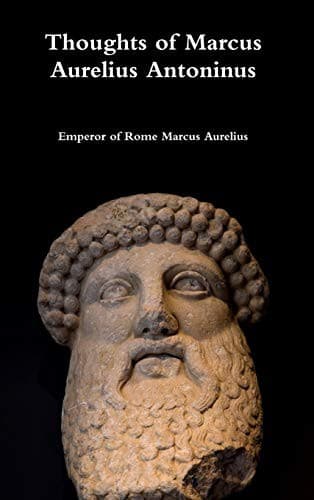
Thoughts of Marcus Aurelius AntoninusMarcus Aurelius, Emperor of Rome
PhilosophyPhilosophy
Thoughts of Marcus Aurelius Antoninus
Marcus Aurelius, Emperor of Rome
Ethics; Life; Marcus Aurelius, Emperor of Rome, 121-180; Stoics
[Greek: aproaireta], [Greek: ta], the things which are not in our will
or power.
[Greek: archê], a first principle.
[Greek: atomoi] (corpora individua, Cic.), atoms.
[Greek: autarkeia] est quae parvo contenta omne id respuit quod abundat
(Cic.); contentment.
[Greek: autarkes], sufficient in itself; contented.
[Greek: aphormai], means, principles. The word has also other
significations in Epictetus. Index ed. Schweig.
[Greek: gignomena], [Greek: ta], things which are produced, come into
existence.
[Greek: daimôn], god, god in man, man's intelligent principle.
[Greek: diathesis], disposition, affection of the mind.
[Greek: diairesis], division of things into their parts, dissection,
resolution, analysis.
[Greek: dialektikê], ars bene disserendi et vera ac falsa dijudicandi
(Cic.).
[Greek: dialysis], dissolution, the opposite of [Greek: sygkrisis].
[Greek: dianoia], understanding; sometimes, the mind generally,
the whole intellectual power.
[Greek: dogmata] (decreta, Cic.), principles.
[Greek: dynamis noera], intellectual faculty.
[Greek: enkrateia], temperance, self-restraint.
[Greek: eidos] in divisione formae sunt, quas Graeci [Greek: eidê]
vocant; nostri, si qui haec forte tractant, species appellant (Cic.).
But [Greek: eidos] is used by Epictetus and Antoninus less exactly and
as a general term, like _genus_. Index Epict. ed. Schweig.--[Greek:
Hôs de ge ahi prôtai ousiai pros ta alla echousin, outô kai to eidos
pros to genos echei hypokeitai gar to eidos tô genei]. (Aristot. Cat.
c. 5.)
[Greek: eimarmenê] (fatalis necessitas, fatum, Cic.), destiny,
necessity.
[Greek: ekkliseis], aversions, avoidance, the turning away from
things; the opposite of [Greek: orexeiz.]
[Greek: empsycha, ta] things which have life.
[Greek: energeia], action, activity.
[Greek: ennoia], [Greek: ennoiai], notio, notiones (Cic.), or "notitiae
rerum;" notions of things. (Notionem appello quam Graeci tum [Greek:
ennoian], tum [Greek: prolêpsin], Cic.).
[Greek: enôsis], [Greek: ê], the unity.
[Greek: epistrophê], attention to an object.
[Greek: euthymia], animi tranquillitas (Cic.).
[Greek: eumenes], [Greek: to], [Greek: eumeneia], benevolence; [Greek:
eumenês] sometimes means well-contented.
[Greek: eunoia], benevolence.
[Greek: exousia], power, faculty.
[Greek: epakolouthêsin], [Greek: kata], by way of sequence.
[Greek: hêgemonikon], [Greek: to], the ruling faculty or part; principatus
(Cic.).
[Greek: theôrêmata], percepta (Cic.), things perceived, general
principles.
[Greek: kathêkein], [Greek: to], duty, "officium."
[Greek: kalos], beautiful.
[Greek: katalêpsis], comprehension; cognitio, perceptio, comprehensio
(Cic.).
[Greek: kataskeuê], constitution.
[Greek: katorthôseis, katorthômata]; recta, recte facta (Cic.); right
acts, those acts to which we proceed by the right or straight road.
[Greek: kosmos], order, world, universe.
Public-domain text, read in full here on John Shaqi.
Reviews
Reviews
No reviews yet
Be the first to share your thoughts on this work.
Elsewhere in the archive
Join the Discussion
Join the discussion
Sign in to leave a comment or review.
Sign InorCreate an account