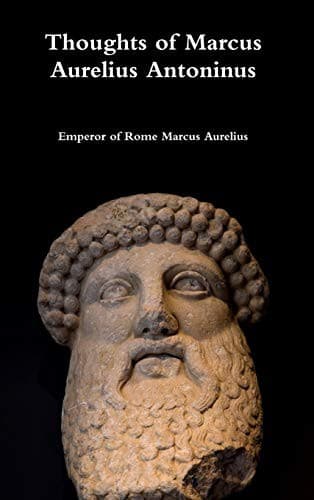
Thoughts of Marcus Aurelius AntoninusMarcus Aurelius, Emperor of Rome
PhilosophyPhilosophy
Thoughts of Marcus Aurelius Antoninus
Marcus Aurelius, Emperor of Rome
Ethics; Life; Marcus Aurelius, Emperor of Rome, 121-180; Stoics
[Greek: kosmos, ho olos], the universe, that which is the One and
the all (vi. 25).
[Greek: krima], a judgment.
[Greek: kyrieuon, to endon], that which rules within (iv. 1), the same
as [Greek: to hêgemonikon]. Diogenes Laertius vii., Zeno. [Greek:
hêgemonikon de einai to kyriôtaton tês psychês].
[Greek: logika, ta], the things which have reason.
[Greek: logikos], rational.
[Greek: logos], reason.
[Greek: logos spermatikos], seminal principle.
[Greek: mesa, ta], things indifferent, viewed with respect to
virtue.
[Greek: noeros], intellectual.
[Greek: nomos], law.
[Greek: nous], intelligence, understanding.
[Greek: oiêsis], arrogance, pride. It sometimes means in Antoninus
the same as [Greek: typhos]; but it also means "opinion."
[Greek: oikonomia] (dispositio, ordo, Cic.) has sometimes the peculiar
sense of artifice, or doing something with an apparent purpose
different from the real purpose.
[Greek: holon, to], the universe, the whole: [Greek: hê tôn olôn physis].
[Greek: onta, ta], things which exist; existence, being.
[Greek: orexis], desire of a thing, which is opposed to [Greek: ekklisis],
aversion.
[Greek: hormê], movement towards an object, appetite; appetitio,
naturalis appetitus, appetitus animi (Cic.).
[Greek: ousia], substance (vi. 49). Modern writers sometimes incorrectly
translate it "essentia." It is often used by Epictetus in the same
sense as [Greek: hylê]. Aristotle (Cat. c. 5) defines [Greek: ousia],
and it is properly translated "substantia" (ed. Jul. Pacius).
Porphyrius (Isag. c. 2): [Greek: hê ousia anôtatô ousa tô mêden pro
autês genos hên to genikôtaton].
[Greek: parakolouthêtikê dynamis, hê], the power which enables us
to observe and understand.
[Greek: peisis], passivity, opposed to [Greek: energeia]: also, affect.
[Greek: peristaseis], circumstances, the things which surround
us; troubles, difficulties.
[Greek: peprômenê, hê], destiny.
[Greek: proairesis], purpose, free will (Aristot. Rhet. i. 13).
[Greek: proaireta, ta], things which are within our will or power.
[Greek: proairetikon, to], free will.
[Greek: prothesis], a purpose, proposition.
[Greek: pronoia] (providentia, Cic.), providence.
[Greek: skopos], object, purpose.
[Greek: stoicheion], element.
[Greek: synkatathesis] (assensio, approbatio, Cic.), assent; [Greek:
synkatatheseis] (probationes, Gellius, xix. 1).
[Greek: synkrimata], things compounded (ii. 3).
[Greek: synkrisis], the act of combining elements out of which
a body is produced, combination.
[Greek: synthesis], ordering, arrangement (compositio).
[Greek: systêma], system, a thing compounded of parts which
have a certain relation to one another.
[Greek: hylê], matter, material.
[Greek: hylikon, to], the material principle.
[Greek: hypexairesis], exception, reservation; [Greek: meth'
hypexaireseôs], conditionally.
Public-domain text, read in full here on John Shaqi.
Reviews
Reviews
No reviews yet
Be the first to share your thoughts on this work.
Elsewhere in the archive
Join the Discussion
Join the discussion
Sign in to leave a comment or review.
Sign InorCreate an account