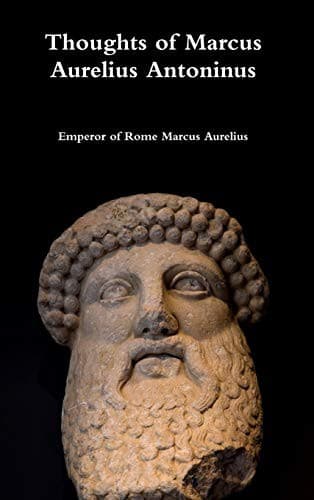
Thoughts of Marcus Aurelius AntoninusMarcus Aurelius, Emperor of Rome
PhilosophyPhilosophy
Thoughts of Marcus Aurelius Antoninus
Marcus Aurelius, Emperor of Rome
Ethics; Life; Marcus Aurelius, Emperor of Rome, 121-180; Stoics
[Greek: hypothesis], material to work on; thing to employ the reason on;
proposition, thing assumed as matter for argument and to lead to
conclusions. (Quaestionum duo sunt genera; alterum infinitum, definitum
alterum. Definitum est, quod [Greek: hypothesin] Graeci, nos
_causam_: infinitum, quod [Greek: thesin] illi appellant, nos
_propositum_ possumus nominare. Cic. See Aristot. Anal. Post.
i. c. 2).
[Greek: hypokeimena, ta], things present or existing, vi. 4; or
things which are a basis or foundation.
[Greek: hypolêpsis], opinion.
[Greek: hypostasis], basis, substance, being, foundation (x. 5).
Epictetus has [Greek: to hypostatikon kai ousiôdes]. (Justinus
ad Diogn. c. 2.)
[Greek: hyphistasthai], to subsist, to be.
[Greek: phantasiai] (visus, Cic.); appearances, thoughts, impressions
(visa animi, Gellius, xix. 1): [Greek: phantasia esti
typôsis en psychê].
[Greek: phantasma], seems to be used by Antoninus in the same
sense as [Greek: phantasia]. Epictetus uses only [Greek: phantasia].
[Greek: phantaston], that which produces a [Greek: phantasia: phantaston
to tepsiêkos tên phantasian aisthêton]
[Greek: physis], nature.
[Greek: physis hê tôn olôn], the nature of the universe.
[Greek: psychê], soul, life, living principle.
[Greek: psychê logikê, noera], a rational soul, an intelligent soul
GENERAL INDEX.
*** The paragraphs (par.) and lines (l.) are those of the sections.
Active, man is by nature, ix. 16.
Advice from the good to be taken, vii. 21; viii. 16.
Affectation, vii. 60; viii. 30; xi. 18 (par. 9), 19.
Anger discouraged, vi. 26, 27; xi. 18.
Anger, offenses of, ii. 10.
Anger, uselessness of, v. 28; viii. 4.
Appearances not to be regarded, v. 36; vi. 3, 13.
Astonishment should not be felt at any thing that happens, viii. 15;
xii. 1 (sub fine), 13.
Attainment, what is within every one's, vii. 67; viii. 8.
Attention to what is said or done, vi. 53; vii. 4, 30; viii. 22.
Bad, the, ii. 1.
Beautiful, the, ii. 1.
Casual. _See_ Formal.
Change keeps the world ever new, vii. 25; viii. 50 (l. 13); xii. 23 (l.
10).
Change, law of, iv. 3 (sub f.), 36, v. 13, 23; vi. 4, 15, 36; vii. 18;
viii. 6; ix. 19, 28 (par. 2), 35; x. 7, 18; xii. 21.
Change, no evil in, iv. 42.
Christians, the xi. 3.
Circle, things come round in a, ii. 14.
Comedy, new, xi. 6.
Comedy, Old, xi. 6.
Complaining, uselessness of, viii. 17, 50.
Connection. _See_ Universe.
Conquerers are robbers, x. 10.
Contentment. _See_ Resignation.
Co-operation. _See_ Mankind and Universe.
Daemon, the, ii. 13, 17; iii. 6 (l. 8), 7, 16 (l. 18); v. 10 (sub f.)
27; xii. 3 (sub. f.).
Death, ii. 11, 12, 17; iii. 3, 7; iv. 5; v. 33; vi. 2, 24, 28; vii. 32;
viii. 20, 58; ix. 3, 21; x. 36; xii. 23, 34, 35.
Death inevitable, iii. 3; iv. 3 (l. 22), 6, 32, 48, 50; v. 33; vi. 47;
viii. 25, 31.
Desire, offenses of, ii. 10.
Destiny, iii. 11 (l. 19); iv. 26; v. 8 (l. 13, etc.), 24; vii. 57; x. 5.
Discontent. _See_ Resignation.
Public-domain text, read in full here on John Shaqi.
Reviews
Reviews
No reviews yet
Be the first to share your thoughts on this work.
Elsewhere in the archive
Join the Discussion
Join the discussion
Sign in to leave a comment or review.
Sign InorCreate an account