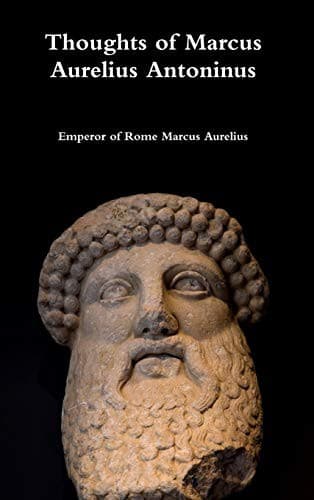
Thoughts of Marcus Aurelius AntoninusMarcus Aurelius, Emperor of Rome
PhilosophyPhilosophy
Thoughts of Marcus Aurelius Antoninus
Marcus Aurelius, Emperor of Rome
Ethics; Life; Marcus Aurelius, Emperor of Rome, 121-180; Stoics
self-evolving power of nature;" a fine phrase indeed, the full import of
which I believe that the writer of it did not see, and thus he laid
himself open to the imputation of being a follower of one of the Hindu
sects, which makes all things come by evolution out of nature or matter,
or out of something which takes the place of Deity, but is not Deity. I
would have all men think as they please, or as they can, and I only
claim the same freedom which I give. When a man writes anything, we may
fairly try to find out all that his words must mean, even if the result
is that they mean what he did not mean; and if we find this
contradiction, it is not our fault, but his misfortune. Now Antoninus is
perhaps somewhat in this condition in what he says (x. 26), though he
speaks at the end of the paragraph of the power which acts, unseen by
the eyes, but still no less clearly. But whether in this passage (x. 26)
lie means that the power is conceived to be in the different successive
causes ([Greek: aitiai]), or in something else, nobody can tell. From
other passages, however, I do collect that his notion of the phenomena
of the universe is what I have stated. The Deity works unseen, if we may
use such language, and perhaps I may, as Job did, or he who wrote the
book of Job. "In him we live and move and are," said St. Paul to the
Athenians; and to show his hearers that this was no new doctrine, he
quoted the Greek poets. One of these poets was the Stoic Cleauthes,
whose noble hymn to Zeus, or God, is an elevated expression of devotion
and philosophy. It deprives Nature of her power, and puts her under the
immediate government of the Deity.
"Thee all this heaven, which whirls around the earth,
Obeys, and willing follows where thou leadest.
Without thee, God, nothing is done on earth,
Nor in the ethereal realms, nor in the sea,
Save what the wicked through their folly do."
Antoninus' conviction of the existence of a divine power and government
was founded on his perception of the order of the universe. Like
Socrates (Xen. Mem., iv. 3, 13, etc.) he says that though we cannot see
the forms of divine powers, we know that they exist because we see their
works.
Public-domain text, read in full here on John Shaqi.
Reviews
Reviews
No reviews yet
Be the first to share your thoughts on this work.
Join the Discussion
Join the discussion
Sign in to leave a comment or review.
Sign InorCreate an account