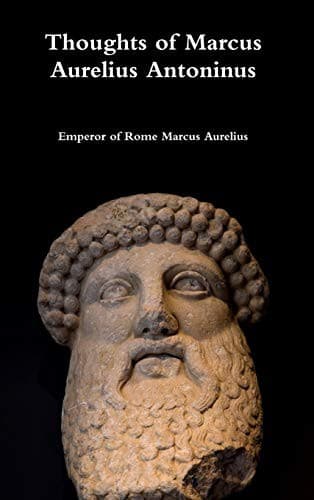
Thoughts of Marcus Aurelius AntoninusMarcus Aurelius, Emperor of Rome
PhilosophyPhilosophy
Thoughts of Marcus Aurelius Antoninus
Marcus Aurelius, Emperor of Rome
Ethics; Life; Marcus Aurelius, Emperor of Rome, 121-180; Stoics
There is in man, that is in the reason, the intelligence, a superior
faculty which if it is exercised rules all the rest. This is the ruling
faculty ([Greek: to hêgemonikon]), which Cicero (De Natura Deorum, ii.
11) renders by the Latin word Principatus, "to which nothing can or
ought to be superior." Antoninus often uses this term and others which
are equivalent. He names it (vii. 64) "the governing intelligence." The
governing faculty is the master of the soul (v. 26). A man must
reverence only his ruling faculty and the divinity within him. As we
must reverence that which is supreme in the universe, so we must
reverence that which is supreme in ourselves; and this is that which is
of like kind with that which is supreme in the universe (v. 21). So, as
Plotinus says, the soul of man can only know the divine so far as it
knows itself. In one passage (xi. 19) Antoninus speaks of a man's
condemnation of himself when the diviner part within him has been
overpowered and yields to the less honorable and to the perishable part,
the body, and its gross pleasures. In a word, the views of Antoninus on
this matter, however his expressions may vary, are exactly what Bishop
Butler expresses when he speaks of "the natural supremacy of reflection
or conscience," of the faculty "which surveys, approves, or disapproves
the several affections of our mind and actions of our lives."
Much matter might be collected from Antoninus on the notion of the
Universe being one animated Being. But all that he says amounts to no
more, as Schultz remarks, than this: the soul of man is most intimately
united to his body, and together they make one animal, which we call
man; so the Deity is most intimately united to the world, or the
material universe, and together they form one whole. But Antoninus did
not view God and the material universe as the same, any more than he
viewed the body and soul of man as one. Antoninus has 110 speculations
on the absolute nature of the Deity. It was not his fashion to waste his
time on what man cannot understand.[A] He was satisfied that God exists,
that he governs all things, that man can only have an imperfect
knowledge of his nature, and he must attain this imperfect knowledge by
reverencing the divinity which is within him, and keeping it pure.
[A] "God, who is infinitely beyond the reach of our narrow
capacities" (Locke, Essay concerning the Human Understanding,
ii. chap. 17).
Public-domain text, read in full here on John Shaqi.
Reviews
Reviews
No reviews yet
Be the first to share your thoughts on this work.
Join the Discussion
Join the discussion
Sign in to leave a comment or review.
Sign InorCreate an account