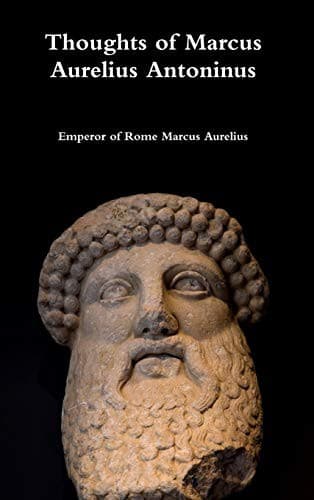
Thoughts of Marcus Aurelius AntoninusMarcus Aurelius, Emperor of Rome
PhilosophyPhilosophy
Thoughts of Marcus Aurelius Antoninus
Marcus Aurelius, Emperor of Rome
Ethics; Life; Marcus Aurelius, Emperor of Rome, 121-180; Stoics
37. Thou wilt soon die, and thou art not yet simple, nor free from
perturbations, nor without suspicion of being hurt by external things,
nor kindly disposed towards all; nor dost thou yet place wisdom only in
acting justly.
38. Examine men's ruling principles, even those of the wise, what kind
of things they avoid, and what kind they pursue.
39. What is evil to thee does not subsist in the ruling principle of
another; nor yet in any turning and mutation of thy corporeal covering.
Where is it then? It is in that part of thee in which subsists the power
of forming opinions about evils. Let this power then not form [such]
opinions, and all is well. And if that which is nearest to it, the poor
body, is cut, burnt, filled with matter and rottenness, nevertheless let
the part which forms opinions about these things be quiet; that is, let
it judge that nothing is either bad or good which can happen equally to
the bad man and the good. For that which happens equally to him who
lives contrary to nature and to him who lives according to nature, is
neither according to nature nor contrary to nature.
40. Constantly regard the universe as one living being, having one
substance and one soul; and observe how all things have reference to one
perception, the perception of this one living being; and how all things
act with one movement; and how all things are the co-operating causes of
all things which exist; observe too the continuous spinning of the
thread and the contexture of the web.
41. Thou art a little soul bearing about a corpse, as Epictetus used to
say (i. c. 19).
42. It is no evil for things to undergo change, and no good for things
to subsist in consequence of change.
43. Time is like a river made up of the events which happen, and a
violent stream; for as soon as a thing has been seen, it is carried
away, and another comes in its place, and this will be carried away too.
44. Everything which happens is as familiar and well known as the rose
in spring and the fruit in summer; for such is disease, and death, and
calumny, and treachery, and whatever else delights fools or vexes them.
45. In the series of things, those which follow are always aptly fitted
to those which have gone before: for this series is not like a mere
enumeration of disjointed things, which has only a necessary sequence,
but it is a rational connection: and as all existing things are arranged
together harmoniously, so the things which come into existence exhibit
no mere succession, but a certain wonderful relationship (vi. 38; vii.
9; vii. 75, note).
Public-domain text, read in full here on John Shaqi.
Reviews
Reviews
No reviews yet
Be the first to share your thoughts on this work.
Elsewhere in the archive
Join the Discussion
Join the discussion
Sign in to leave a comment or review.
Sign InorCreate an account