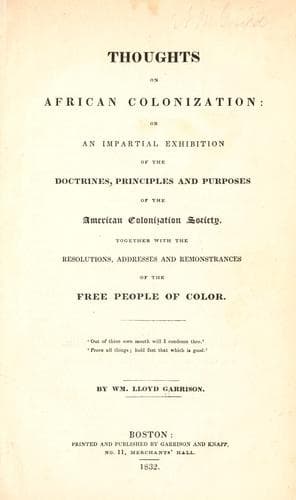
Thoughts on African ColonizationGarrison, William Lloyd
Philosophy
Thoughts on African Colonization
Garrison, William Lloyd
African Americans -- Colonization -- Africa; American Colonization Society; Slavery -- United States
'Many of those citizens who ardently wish for the removal of
such of the free colored population, as are willing to go, to
any place where they could enjoy, _what they can never enjoy
here_, that is, all the advantages of society,' &c. * * 'That
the free colored population in this country labor under the most
oppressive disadvantages, which their freedom can by no means
counterbalance, is too obvious to admit of doubt. I waive all
inquiry whether this is right or wrong. I speak of things as
they are--not as they might, or as they ought to be. They are
cut off from the most remote chance of amalgamation with the
white population, by feelings or prejudices, call them what you
will, that are ineradicable. Their situation is more unfavorable
than that of many slaves. "With all the burdens, cares and
responsibilities of freedom, they have few or none of its
substantial benefits. Their associations are, and must be,
chiefly with slaves. Their right of suffrage gives them little,
if any, political influence, and they are practically, if not
theoretically excluded from representation and weight in our
public councils." _No merit, no services, no talents can elevate
them to a level with the whites._ Occasionally, an exception may
arise. A colored individual, of great talents, merits, and
wealth, may emerge from the crowd. Cases of this kind are to the
last degree rare. The colored people are subject to legal
disabilities, more or less galling and severe, in almost every
state of the Union. Who has not deeply regretted their late
harsh expulsion from the State of Ohio, and their being forced
to abandon the country of their birth, which had profited by
their labors, and to take refuge in a foreign land? Severe
regulations have been recently passed in Louisiana, to prevent
the introduction of free people of color into the State.
Whenever they appear, they are to be banished in sixty days. The
strong opposition to a negro college in New-Haven, speaks in a
language not to be mistaken, the jealousy with which they are
regarded. And there is no reason to expect, that the lapse of
centuries will make any change in this respect. THEY WILL ALWAYS
UNHAPPILY BE REGARDED AS AN INFERIOR RACE.'--[Mathew Carey's
'Reflections.']
'Instances of emancipation have not essentially benefitted the
African, and _probably never will_, while he remains among us.
In this country, public opinion does, _and will_, consign him to
an inferiority, _above which he can never rise_. Emancipation
can NEVER make the African, while he remains in this country, a
real free man. Degradation MUST and WILL press him to the earth;
no cheering, stimulating influence will he here feel, _in any of
the walks of life_.'--[Circular of the Massachusetts
Colonization Society for 1832.]
Public-domain text, read in full here on John Shaqi.
Reviews
Reviews
No reviews yet
Be the first to share your thoughts on this work.
Elsewhere in the archive
Join the Discussion
Join the discussion
Sign in to leave a comment or review.
Sign InorCreate an account