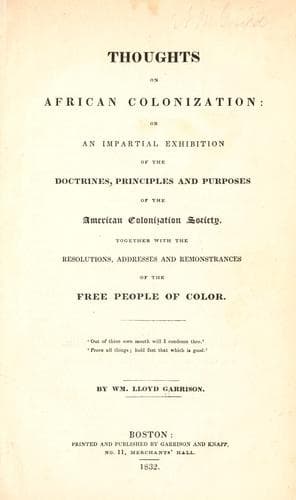
Thoughts on African ColonizationGarrison, William Lloyd
Philosophy
Thoughts on African Colonization
Garrison, William Lloyd
African Americans -- Colonization -- Africa; American Colonization Society; Slavery -- United States
Great Britain and the United States, the two most favored, and
the two most guilty nations upon earth, both need rebuke. They
ought to be brethren, mutually dear and honorable to each other,
in all that is true and kind. But never, never, let them support
one another in guilt.
People of Great Britain, it is your business--it is _your
duty_,--to give to negro slavery no rest, but to put it
down--not by letting the trunk alone, while you idly busy
yourselves in lopping off, or in aiding others to lop off, a few
of the straggling branches--but by laying the axe at once to
its roots, and by putting your united nerve into the steel, till
this great poison-tree of lust and blood, and of all abominable
and heartless iniquity, fall before you; and law, and love, and
God and man, shout victory over its ruin.
Hearken--thus saith the Lord, "Rob not the poor, because he is
poor; neither oppress the afflicted in the gate. For the Lord
will plead their cause, and spoil the soul of those that spoiled
them." Prov. xxii. 22, 23.
LONDON, July 15, 1831. C. STUART.'[Y]
Sometimes the Society professes to be able to remove the whole colored
population in less than thirty years! and the belief is prevalent that
the project is feasible. Again it tells us--
'Admitting that the colonization scheme contemplates the
ultimate abolition of slavery, yet that result could only be
produced _by the gradual and slow operation of_ CENTURIES.' * *
'How came we by this population? By the prevalence for a century
of a guilty commerce. And will not the prevalence _for a
century_ of a restoring commerce, place them on their own
shores? Yes, surely!' * * 'There are those, Sir, who ask--and
could not a quarter century cease and determine the two great
evils? You and I, my dear Sir, on whom the frost of time has
fallen rather perceptibly, would say a century. And now, let me
ask, could ever a century, in the whole course of human affairs,
be better employed?'--[African Repository, vol. i. pp. 217, 347;
vol. v. p. 366.]
'It is not the work of a day nor a year, it is not a work of one
time, nor of two, nor of three, but it is one which will now
commence, _and may continue for ages_.'--[A new and interesting
View of Slavery. By Humanitas, a colonization advocate.
Baltimore, 1820.]
Wild enthusiasts in the cause may respond--'The Society never expected
to accomplish much single-handed: it is about to enlist the energies of
the General Government--and doubtless Congress will appropriate several
millions of dollars annually for the purchase and colonization of the
slaves.'
Public-domain text, read in full here on John Shaqi.
Reviews
Reviews
No reviews yet
Be the first to share your thoughts on this work.
Elsewhere in the archive
Join the Discussion
Join the discussion
Sign in to leave a comment or review.
Sign InorCreate an account