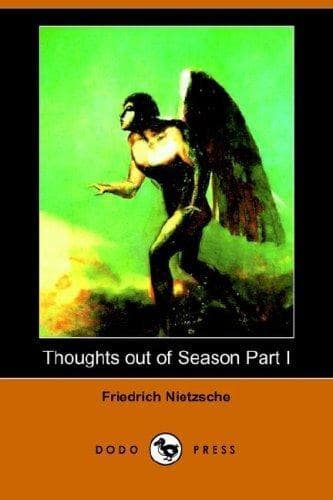
Thoughts out of Season, Part INietzsche, Friedrich Wilhelm
PhilosophyPhilosophy
Thoughts out of Season, Part I
Nietzsche, Friedrich Wilhelm
Philosophy, German; Strauss, David Friedrich, 1808-1874; Wagner, Richard, 1813-1883
accessary words, vanish, and his pen dashes off sentences, and even
whole pages, which belong to the best in German prose. But even
admitting that while he wrote such passages he was addressing friends,
and that the shadow of his enemies had been removed for a while, all
the friends and enemies that Wagner, as a man of letters, has, possess
one factor in common, which differentiates them fundamentally from the
"people" for whom he worked as an artist. Owing to the refining and
fruitless nature of their education, they are quite devoid of the
essential traits of the national character, and he who would appeal to
them must speak in a way which is not of the people--that is to say,
after the manner of our best prose-writers and Wagner himself; though
that he did violence to himself in writing thus is evident. But the
strength of that almost maternal instinct of prudence in him, which is
ready to make any sacrifice, rather tends to reinstall him among the
scholars and men of learning, to whom as a creator he always longed to
bid farewell. He submits to the language of culture and all the laws
governing its use, though he was the first to recognise its profound
insufficiency as a means of communication.
For if there is anything that distinguishes his art from every other
art of modern times, it is that it no longer speaks the language of
any particular caste, and refuses to admit the distinctions "literate"
and "illiterate." It thus stands as a contrast to every culture of the
Renaissance, which to this day still bathes us modern men in its light
and shade. Inasmuch as Wagner's art bears us, from time to time,
beyond itself, we are enabled to get a general view of its uniform
character: we see Goethe and Leopardi as the last great stragglers of
the Italian philologist-poets, Faust as the incarnation of a most
unpopular problem, in the form of a man of theory thirsting for life;
even Goethe's song is an imitation of the song of the people rather
than a standard set before them to which they are expected to attain,
and the poet knew very well how truly he spoke when he seriously
assured his adherents: "My compositions cannot become popular; he who
hopes and strives to make them so is mistaken."
That an art could arise which would be so clear and warm as to flood
the base and the poor in spirit with its light, as well as to melt the
haughtiness of the learned--such a phenomenon had to be experienced
though it could not be guessed. But even in the mind of him who
experiences it to-day it must upset all preconceived notions
concerning education and culture; to such an one the veil will seem to
have been rent in twain that conceals a future in which no highest
good or highest joys exist that are not the common property of all.
The odium attaching to the word "common" will then be abolished.
Public-domain text, read in full here on John Shaqi.
Reviews
Reviews
No reviews yet
Be the first to share your thoughts on this work.
Elsewhere in the archive
Join the Discussion
Join the discussion
Sign in to leave a comment or review.
Sign InorCreate an account