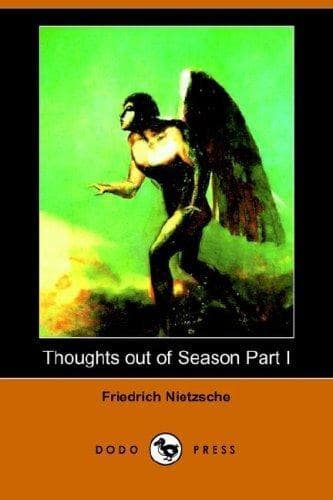
Thoughts out of Season, Part INietzsche, Friedrich Wilhelm
PhilosophyPhilosophy
Thoughts out of Season, Part I
Nietzsche, Friedrich Wilhelm
Philosophy, German; Strauss, David Friedrich, 1808-1874; Wagner, Richard, 1813-1883
If presentiment venture thus into the remote future, the discerning
eye of all will recognise the dreadful social insanity of our present
age, and will no longer blind itself to the dangers besetting an art
which seems to have roots only in the remote and distant future, and
which allows its burgeoning branches to spread before our gaze when it
has not yet revealed the ground from which it draws its sap. How can
we protect this homeless art through the ages until that remote future
is reached? How can we so dam the flood of a revolution seemingly
inevitable everywhere, that the blessed prospect and guarantee of a
better future--of a freer human life--shall not also be washed away
with all that is destined to perish and deserves to perish?
He who asks himself this question shares Wagner's care: he will feel
himself impelled with Wagner to seek those established powers that
have the goodwill to protect the noblest passions of man during the
period of earthquakes and upheavals. In this sense alone Wagner
questions the learned through his writings, whether they intend
storing his legacy to them--the precious Ring of his art--among their
other treasures. And even the wonderful confidence which he reposes in
the German mind and the aims of German politics seems to me to arise
from the fact that he grants the people of the Reformation that
strength, mildness, and bravery which is necessary in order to divert
"the torrent of revolution into the tranquil river-bed of a calmly
flowing stream of humanity": and I could almost believe that this and
only this is what he meant to express by means of the symbol of his
Imperial march.
As a rule, though, the generous impulses of the creative artist and
the extent of his philanthropy are too great for his gaze to be
confined within the limits of a single nation. His thoughts, like
those of every good and great German, are more than German, and the
language of his art does not appeal to particular races but to mankind
in general.
But to the men of the future.
Public-domain text, read in full here on John Shaqi.
Reviews
Reviews
No reviews yet
Be the first to share your thoughts on this work.
Elsewhere in the archive
Join the Discussion
Join the discussion
Sign in to leave a comment or review.
Sign InorCreate an account