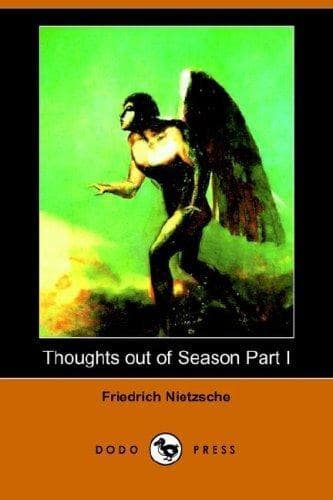
Thoughts out of Season, Part INietzsche, Friedrich Wilhelm
PhilosophyPhilosophy
Thoughts out of Season, Part I
Nietzsche, Friedrich Wilhelm
Philosophy, German; Strauss, David Friedrich, 1808-1874; Wagner, Richard, 1813-1883
This is the belief that is proper to him; this is his torment and his
distinction. No artist, of what past soever, has yet received such a
remarkable portion of genius; no one, save him, has ever been obliged
to mix this bitterest of ingredients with the drink of nectar to which
enthusiasm helped him. It is not as one might expect, the
misunderstood and mishandled artist, the fugitive of his age, who
adopted this faith in self-defence: success or failure at the hands of
his contemporaries was unable either to create or to destroy it
Whether it glorified or reviled him, he did not belong to this
generation: that was the conclusion to which his instincts led him.
And the possibility of any generation's ever belonging to him is
something which he who disbelieves in Wagner can never be made to
admit. But even this unbeliever may at least ask, what kind of
generation it will be in which Wagner will recognise his "people," and
in which he will see the type of all those who suffer a common
distress, and who wish to escape from it by means of an art common to
them all. Schiller was certainly more hopeful and sanguine; he did not
ask what a future must be like if the instinct of the artist that
predicts it prove true; his command to every artist was rather--
Soar aloft in daring flight Out of sight of thine own years! In thy
mirror, gleaming bright, Glimpse of distant dawn appears.
XI.
May blessed reason preserve us from ever thinking that mankind will at
any time discover a final and ideal order of things, and that
happiness will then and ever after beam down upon us uniformly, like
the rays of the sun in the tropics. Wagner has nothing to do with such
a hope; he is no Utopian. If he was unable to dispense with the belief
in a future, it only meant that he observed certain properties in
modern men which he did not hold to be essential to their nature, and
which did not seem to him to form any necessary part of their
constitution; in fact, which were changeable and transient; and that
precisely owing to these properties art would find no home among them,
and he himself had to be the precursor and prophet of another epoch.
No golden age, no cloudless sky will fall to the portion of those
future generations, which his instinct led him to expect, and whose
approximate characteristics may be gleaned from the cryptic characters
of his art, in so far as it is possible to draw conclusions concerning
the nature of any pain from the kind of relief it seeks. Nor will
superhuman goodness and justice stretch like an everlasting rainbow
over this future land. Belike this coming generation will, on the
whole, seem more evil than the present one--for in good as in evil it
will be more straightforward. It is even possible, if its soul were
ever able to speak out in full and unembarrassed tones, that it might
convulse and terrify us, as though the voice of some hitherto
concealed and evil spirit had suddenly cried out in our midst.
Public-domain text, read in full here on John Shaqi.
Reviews
Reviews
No reviews yet
Be the first to share your thoughts on this work.
Elsewhere in the archive
Join the Discussion
Join the discussion
Sign in to leave a comment or review.
Sign InorCreate an account