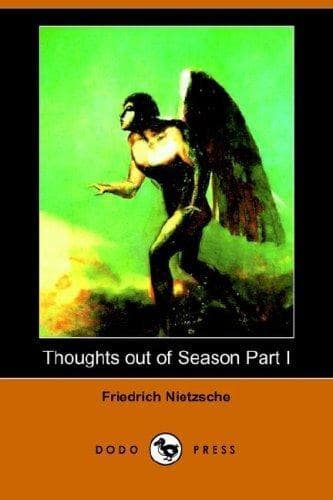
Thoughts out of Season, Part INietzsche, Friedrich Wilhelm
PhilosophyPhilosophy
Thoughts out of Season, Part I
Nietzsche, Friedrich Wilhelm
Philosophy, German; Strauss, David Friedrich, 1808-1874; Wagner, Richard, 1813-1883
The friendship which grew between them was of that rare order in which
neither can tell who influences the other more. Wagner would often
declare that the beautiful music in the third act of Siegfried was to
be ascribed to Nietzsche's influence over him; he also adopted the
young man's terminology in art matters, and the concepts implied by
the words "Dionysian" and "Apollonian" were borrowed by him from his
friend's discourses. How much Nietzsche owed to Wagner may perhaps
never be definitely known; to those who are sufficiently interested to
undertake the investigation of this matter, we would recommend Hans
Belart's book, Nietzsche's Ethik; in it references will be found which
give some clue as to the probable sources from which the necessary
information may be derived. In any case, however, the reciprocal
effects of their conversations will never be exactly known; and
although it would be ridiculous to assume that Nietzsche was
essentially the same when he left as when he met him, what the real
nature of the change was it is now difficult to say.
For some years their friendship continued firm, and grew ever more and
more intimate. The Birth Of Tragedy was one of the first public
declarations of it, and after its publication many were led to
consider that Wagner's art was a sort of resurrection of the Dionysian
Grecian art. Enemies of Nietzsche began to whisper that he was merely
Wagner's "literary lackey"; many friends frowned upon the promising
young philologist, and questioned the exaggerated importance he was
beginning to ascribe to the art of music and to art in general, in
their influence upon the world; and all the while Nietzsche's one
thought and one aim was to help the cause and further the prospects of
the man who he earnestly believed was destined to be the salvation of
European culture.
Every great ideal coined in his own brain he imagined to be the ideal
of his hero; all his sublimest hopes for society were presented
gratis, in his writings, to Wagner, as though products of the latter's
own mind; and just as the prophet of old never possessed the requisite
assurance to suppose that his noblest ideas were his own, but
attributed them to some higher and supernatural power, whom he thereby
learnt to worship for its fancied nobility of sentiment, so Nietzsche,
still doubting his own powers, created a fetich out of nis most
distinguished friend, and was ultimately wounded and well-nigh wrecked
with disappointment when he found that the Wagner of the
Gotterdammerung and Parsifal was not the Wagner of his own mind.
Public-domain text, read in full here on John Shaqi.
Reviews
Reviews
No reviews yet
Be the first to share your thoughts on this work.
Join the Discussion
Join the discussion
Sign in to leave a comment or review.
Sign InorCreate an account