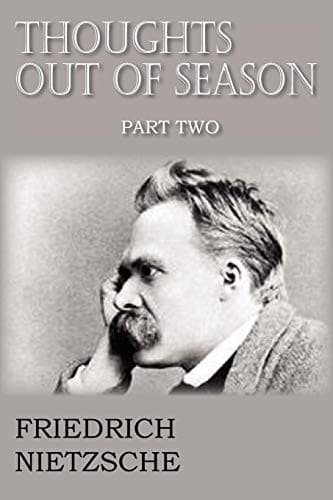
Thoughts Out of Season, Part IINietzsche, Friedrich Wilhelm
PhilosophyPhilosophy
Thoughts Out of Season, Part II
Nietzsche, Friedrich Wilhelm
History -- Study and teaching; Schopenhauer, Arthur, 1788-1860
The state has never any concern with truth, but only with the truth
useful to it, or rather, with anything that is useful to it, be it
truth, half-truth, or error. A coalition between state and philosophy
has only meaning when the latter can promise to be unconditionally
useful to the state, to put its well-being higher than truth. It
would certainly be a noble thing for the state to have truth as a
paid servant; but it knows well enough that it is the essence of
truth to be paid nothing and serve nothing. So the state's servant
turns out to be merely "false truth," a masked actor who cannot
perform the office required from the real truth--the affirmation of
the state's worth and sanctity. When a mediæval prince wished to be
crowned by the Pope, but could not get him to consent, he appointed
an antipope to do the business for him. This may serve up to a
certain point; but not when the modern state appoints an
"anti-philosophy" to legitimise it; for it has true philosophy
against it just as much as before, or even more so. I believe in all
seriousness that it is to the state's advantage to have nothing
further to do with philosophy, to demand nothing from it, and let it
go its own way as much as possible. Without this indifferent
attitude, philosophy may become dangerous and oppressive, and will
have to be persecuted.--The only interest the state can have in the
university lies in the training of obedient and useful citizens; and
it should hesitate to put this obedience and usefulness in doubt by
demanding an examination in philosophy from the young men. To make a
bogey of philosophy may be an excellent way to frighten the idle and
incompetent from its study; but this advantage is not enough to
counterbalance the danger that this kind of compulsion may arouse
from the side of the more reckless and turbulent spirits. They learn
to know about forbidden books, begin to criticise their teachers, and
finally come to understand the object of university philosophy and
its examinations; not to speak of the doubts that may be fostered in
the minds of young theologians, as a consequence of which they are
beginning to be extinct in Germany, like the ibexes in the Tyrol.
Public-domain text, read in full here on John Shaqi.
Reviews
Reviews
No reviews yet
Be the first to share your thoughts on this work.
Elsewhere in the archive
Join the Discussion
Join the discussion
Sign in to leave a comment or review.
Sign InorCreate an account