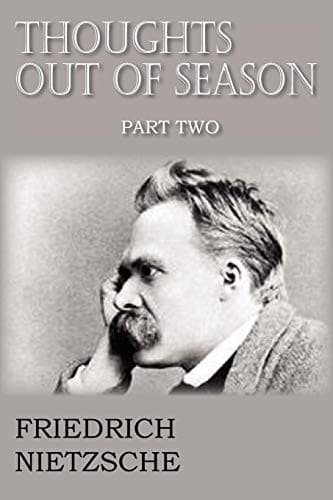
Thoughts Out of Season, Part IINietzsche, Friedrich Wilhelm
PhilosophyPhilosophy
Thoughts Out of Season, Part II
Nietzsche, Friedrich Wilhelm
History -- Study and teaching; Schopenhauer, Arthur, 1788-1860
I know the objections that the state could bring against all this, as
long as the lovely Hegel-corn was yellowing in all the fields; but
now that hail has destroyed the crop and all men's hopes of it, now
that nothing has been fulfilled and all the barns are empty,--there
are no more objections to be made, but rather rejections of
philosophy itself. The state has now the power of rejection; in
Hegel's time it only wished to have it--and that makes a great
difference. The state needs no more the sanction of philosophy, and
philosophy has thus become superfluous to it. It will find advantage
in ceasing to maintain its professors, or (as I think will soon
happen) in merely pretending to maintain them; but it is of still
greater importance that the university should see the benefit of this
as well. At least I believe the real sciences must see that their
interest lies in freeing themselves from all contact with sham
science. And further, the reputation of the universities hangs too
much in the balance for them not to welcome a severance from methods
that are thought little of even in academic circles. The outer world
has good reason for its widespread contempt of universities; they are
reproached with being cowardly, the small fearing the great, and the
great fearing public opinion; it is said that they do not lead the
higher thought of the age but hobble slowly behind it, and cleave no
longer to the fundamental ideas of the recognised sciences. Grammar,
for example, is studied more diligently than ever without any one
seeing the necessity of a rigorous training in speech and writing.
The gates of Indian antiquity are being opened, and the scholars have
no more idea of the most imperishable works of the Indians--their
philosophies--than a beast has of playing the harp; though
Schopenhauer thinks that the acquaintance with Indian philosophy is
one of the greatest advantages possessed by our century. Classical
antiquity is the favourite playground nowadays, and its effect is no
longer classical and formative; as is shown by the students, who are
certainly no models for imitation. Where is now the spirit of
Friedrich August Wolf to be found, of whom Franz Passow could say
that he seemed a loyal and humanistic spirit with force enough to set
half the world aflame? Instead of that a journalistic spirit is
arising in the university, often under the name of philosophy; the
smooth delivery--the very cosmetics of speech--with Faust and Nathan
the Wise for ever on the lips, the accent and the outlook of our
worst literary magazines and, more recently, much chatter about our
holy German music, and the demand for lectures on Schiller and
Goethe,--all this is a sign that the university spirit is beginning
to be confused with the Spirit of the Age. Thus the establishment of
a higher tribunal, outside the universities, to protect and criticise
them with regard to culture, would seem a most valuable thing, and as
Public-domain text, read in full here on John Shaqi.
Reviews
Reviews
No reviews yet
Be the first to share your thoughts on this work.
Elsewhere in the archive
Join the Discussion
Join the discussion
Sign in to leave a comment or review.
Sign InorCreate an account