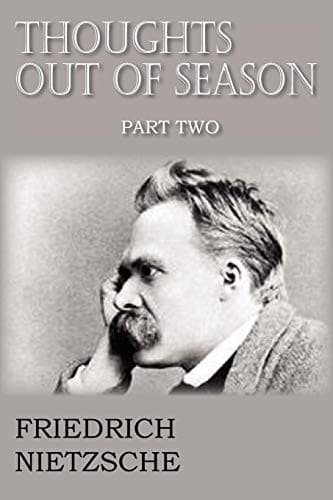
Thoughts Out of Season, Part IINietzsche, Friedrich Wilhelm
PhilosophyPhilosophy
Thoughts Out of Season, Part II
Nietzsche, Friedrich Wilhelm
History -- Study and teaching; Schopenhauer, Arthur, 1788-1860
soon as philosophy can sever itself from the universities and be
purified from every unworthy motive or hypocrisy, it will be able to
become such a tribunal. It will do its work without state help in
money or honours, free from the spirit of the age as well as from any
fear of it; being in fact the judge, as Schopenhauer was, of the
so-called culture surrounding it. And in this way the philosopher can
also be useful to the university, by refusing to be a part of it, but
criticising it from afar. Distance will lend dignity.
But, after all, what does the life of a state or the progress of
universities matter in comparison with the life of philosophy on
earth! For, to say quite frankly what I mean, it is infinitely more
important that a philosopher should arise on the earth than that a
state or a university should continue. The dignity of philosophy may
rise in proportion as the submission to public opinion and the danger
to liberty increase; it was at its highest during the convulsions
marking the fall of the Roman Republic, and in the time of the
Empire, when the names of both philosophy and history became _ingrata
principibus nomina_. Brutus shows its dignity better than Plato; his
was a time when ethics cease to have commonplaces. Philosophy is not
much regarded now, and we may well ask why no great soldier or
statesman has taken it up; and the answer is that a thin phantom has
met him under the name of philosophy, the cautious wisdom of the
learned professor; and philosophy has soon come to seem ridiculous to
him. It ought to have seemed terrible; and men who are called to
authority should know the heroic power that has its source there. An
American may tell them what a centre of mighty forces a great thinker
can prove on this earth. "Beware when the great God lets loose a
thinker on this planet," says Emerson.[3] "Then all things are at
risk. It is as when a conflagration has broken out in a great city,
and no man knows what is safe, or where it will end. There is not a
piece of science, but its flank may be turned to-morrow; there is not
any literary reputation, not the so-called eternal names of fame,
that may not be revised and condemned.... The things which are dear
to men at this hour are so on account of the ideas which have emerged
on their mental horizon, and which cause the present order of things
as a tree bears its apples. A new degree of culture would instantly
revolutionise the entire system of human pursuits." If such thinkers
are dangerous, it is clear why our university thinkers are not
dangerous; for their thoughts bloom as peacefully in the shade of
tradition "as ever tree bore its apples." They do not frighten; they
carry away no gates of Gaza; and to all their little contemplations
one can make the answer of Diogenes when a certain philosopher was
praised: "What great result has he to show, who has so long practised
philosophy and yet has _hurt_ nobody?" Yes, the university philosophy
Public-domain text, read in full here on John Shaqi.
Reviews
Reviews
No reviews yet
Be the first to share your thoughts on this work.
Elsewhere in the archive
Join the Discussion
Join the discussion
Sign in to leave a comment or review.
Sign InorCreate an account