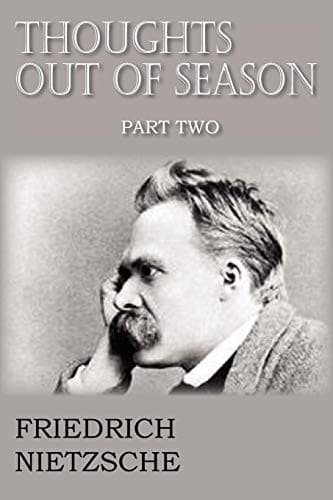
Thoughts Out of Season, Part IINietzsche, Friedrich Wilhelm
PhilosophyPhilosophy
Thoughts Out of Season, Part II
Nietzsche, Friedrich Wilhelm
History -- Study and teaching; Schopenhauer, Arthur, 1788-1860
And yet if we really wish to learn something from an example, how
vague and elusive do we find the comparison! If it is to give us
strength, many of the differences must be neglected, the
individuality of the past forced into a general formula and all the
sharp angles broken off for the sake of correspondence. Ultimately,
of course, what was once possible can only become possible a second
time on the Pythagorean theory, that when the heavenly bodies are in
the same position again, the events on earth are reproduced to the
smallest detail; so when the stars have a certain relation, a Stoic
and an Epicurean will form a conspiracy to murder Cæsar, and a
different conjunction will show another Columbus discovering America.
Only if the earth always began its drama again after the fifth act,
and it were certain that the same interaction of motives, the same
_deus ex machina_, the same catastrophe would occur at particular
intervals, could the man of action venture to look for the whole
archetypic truth in monumental history, to see each fact fully set
out in its uniqueness: it would not probably be before the
astronomers became astrologers again. Till then monumental history
will never be able to have complete truth; it will always bring
together things that are incompatible and generalise them into
compatibility, will always weaken the differences of motive and
occasion. Its object is to depict effects at the expense of the
causes--"monumentally," that is, as examples for imitation: it turns
aside, as far as it may, from reasons, and might be called with far
less exaggeration a collection of "effects in themselves," than of
events that will have an effect on all ages. The events of war or
religion cherished in our popular celebrations are such "effects in
themselves"; it is these that will not let ambition sleep, and lie
like amulets on the bolder hearts--not the real historical nexus of
cause and effect, which, rightly understood, would only prove that
nothing quite similar could ever be cast again from the dice-boxes of
fate and the future.
Public-domain text, read in full here on John Shaqi.
Reviews
Reviews
No reviews yet
Be the first to share your thoughts on this work.
Join the Discussion
Join the discussion
Sign in to leave a comment or review.
Sign InorCreate an account