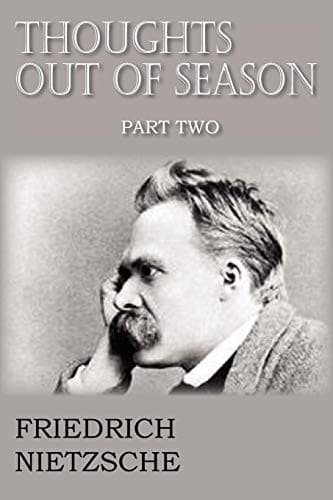
Thoughts Out of Season, Part IINietzsche, Friedrich Wilhelm
PhilosophyPhilosophy
Thoughts Out of Season, Part II
Nietzsche, Friedrich Wilhelm
History -- Study and teaching; Schopenhauer, Arthur, 1788-1860
a conflict between our innate, inherited nature and our knowledge,
between a stern, new discipline and an ancient tradition; and we
plant a new way of life, a new instinct, a second nature, that
withers the first. It is an attempt to gain a past _a posteriori_
from which we might spring, as against that from which we do spring;
always a dangerous attempt, as it is difficult to find a limit to the
denial of the past, and the second natures are generally weaker than
the first. We stop too often at knowing the good without doing it,
because we also know the better but cannot do it. Here and there the
victory is won, which gives a strange consolation to the fighters, to
those who use critical history for the sake of life. The consolation
is the knowledge that this "first nature" was once a second, and that
every conquering "second nature" becomes a first.
IV.
This is how history can serve life. Every man and nation needs a
certain knowledge of the past, whether it be through monumental,
antiquarian, or critical history, according to his objects, powers,
and necessities. The need is not that of the mere thinkers who only
look on at life, or the few who desire knowledge and can only be
satisfied with knowledge; but it has always a reference to the end of
life, and is under its absolute rule and direction. This is the
natural relation of an age, a culture and a people to history; hunger
is its source, necessity its norm, the inner plastic power assigns
its limits. The knowledge of the past is only desired for the service
of the future and the present, not to weaken the present or undermine
a living future. All this is as simple as truth itself, and quite
convincing to any one who is not in the toils of "historical
deduction."
And now to take a quick glance at our time! We fly back in
astonishment. The clearness, naturalness, and purity of the
connection between life and history has vanished; and in what a maze
of exaggeration and contradiction do we now see the problem! Is the
guilt ours who see it, or have life and history really altered their
conjunction and an inauspicious star risen between them? Others may
prove we have seen falsely; I am merely saying what we believe we
see. There is such a star, a bright and lordly star, and the
conjunction is really altered--by science, and the demand for history
to be a science. Life is no more dominant, and knowledge of the past
no longer its thrall: boundary marks are overthrown everything bursts
its limits. The perspective of events is blurred, and the blur
extends through their whole immeasurable course. No generation has
seen such a panoramic comedy as is shown by the "science of universal
evolution," history; that shows it with the dangerous audacity of its
motto--"Fiat veritas, pereat vita."
Public-domain text, read in full here on John Shaqi.
Reviews
Reviews
No reviews yet
Be the first to share your thoughts on this work.
Join the Discussion
Join the discussion
Sign in to leave a comment or review.
Sign InorCreate an account