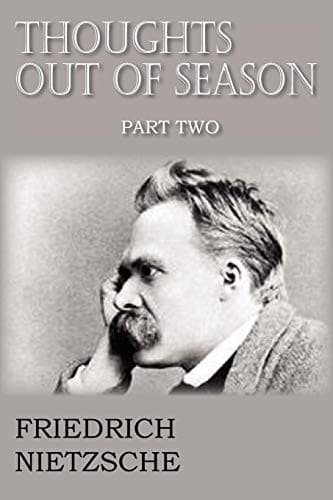
Thoughts Out of Season, Part IINietzsche, Friedrich Wilhelm
PhilosophyPhilosophy
Thoughts Out of Season, Part II
Nietzsche, Friedrich Wilhelm
History -- Study and teaching; Schopenhauer, Arthur, 1788-1860
filling ourselves to overflowing with foreign customs, arts,
philosophies, religions and sciences: we are wandering encyclopædias,
as an ancient Greek who had strayed into our time would probably call
us. But the only value of an encyclopædia lies in the inside, in the
contents, not in what is written outside, in the binding or the
wrapper. And so the whole of modern culture is essentially internal;
the bookbinder prints something like this on the cover: "Manual of
internal culture for external barbarians." The opposition of inner
and outer makes the outer side still more barbarous, as it would
naturally be, when the outward growth of a rude people merely
developed its primitive inner needs. For what means has nature of
repressing too great a luxuriance from without? Only one,--to be
affected by it as little as possible, to set it aside and stamp it
out at the first opportunity. And so we have the custom of no longer
taking real things seriously, we get the feeble personality on which
the real and the permanent make so little impression. Men become at
last more careless and accommodating in external matters, and the
considerable cleft between substance and form is widened; until they
have no longer any feeling for barbarism, if only their memories be
kept continually titillated, and there flow a constant stream of new
things to be known, that can be neatly packed up in the cupboards of
their memory. The culture of a people as against this barbarism, can
be, I think, described with justice as the "unity of artistic style
in every outward expression of the people's life." This must not be
misunderstood, as though it were merely a question of the opposition
between barbarism and "fine style." The people that can be called
cultured, must be in a real sense a living unity, and not be
miserably cleft asunder into form and substance. If one wish to
promote a people's culture, let him try to promote this higher unity
first, and work for the destruction of the modern educative system
for the sake of a true education. Let him dare to consider how the
health of a people that has been destroyed by history may be
restored, and how it may recover its instincts with its honour.
Public-domain text, read in full here on John Shaqi.
Reviews
Reviews
No reviews yet
Be the first to share your thoughts on this work.
Join the Discussion
Join the discussion
Sign in to leave a comment or review.
Sign InorCreate an account