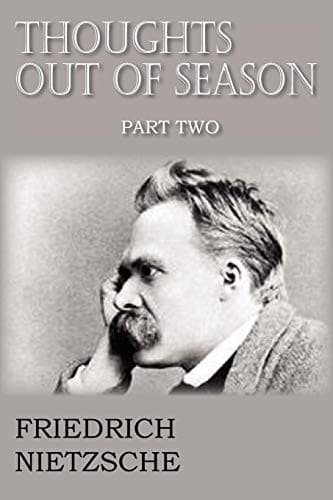
Thoughts Out of Season, Part IINietzsche, Friedrich Wilhelm
PhilosophyPhilosophy
Thoughts Out of Season, Part II
Nietzsche, Friedrich Wilhelm
History -- Study and teaching; Schopenhauer, Arthur, 1788-1860
Consider the historical virtuoso of the present time: is he the
justest man of his age? True, he has developed in himself such a
delicacy and sensitiveness that "nothing human is alien to him."
Times and persons most widely separated come together in the concords
of his lyre. He has become a passive instrument, whose tones find an
echo in similar instruments: until the whole atmosphere of a time is
filled with such echoes, all buzzing in one soft chord. Yet I think
one only hears the overtones of the original historical note: its
rough powerful quality can be no longer guessed from these thin and
shrill vibrations. The original note sang of action, need, and
terror; the overtone lulls us into a soft dilettante sleep. It is as
though the heroic symphony had been arranged for two flutes for the
use of dreaming opium-smokers. We can now judge how these virtuosi
stand towards the claim of the modern man to a higher and purer
conception of justice. This virtue has never a pleasing quality; it
never charms; it is harsh and strident. Generosity stands very low on
the ladder of the virtues in comparison; and generosity is the mark
of a few rare historians! Most of them only get as far as tolerance,
in other words they leave what cannot be explained away, they correct
it and touch it up condescendingly, on the tacit assumption that the
novice will count it as justice if the past be narrated without
harshness or open expressions of hatred. But only superior strength
can really judge; weakness must tolerate, if it do not pretend to be
strength and turn justice to a play-actress. There is still a
dreadful class of historians remaining--clever, stern and honest, but
narrow-minded: who have the "good will" to be just with a pathetic
belief in their actual judgments, which are all false; for the same
reason, almost, as the verdicts of the usual juries are false. How
difficult it is to find a real historical talent, if we exclude all
the disguised egoists, and the partisans who pretend to take up an
impartial attitude for the sake of their own unholy game! And we also
exclude the thoughtless folk who write history in the naïve faith
that justice resides in the popular view of their time, and that to
write in the spirit of the time is to be just; a faith that is found
in all religions, and which, in religion, serves very well. The
measurement of the opinions and deeds of the past by the universal
opinions of the present is called "objectivity" by these simple
people: they find the canon of all truth here: their work is to adapt
the past to the present triviality. And they call all historical
writing "subjective" that does not regard these popular opinions as
canonical.
Public-domain text, read in full here on John Shaqi.
Reviews
Reviews
No reviews yet
Be the first to share your thoughts on this work.
Join the Discussion
Join the discussion
Sign in to leave a comment or review.
Sign InorCreate an account