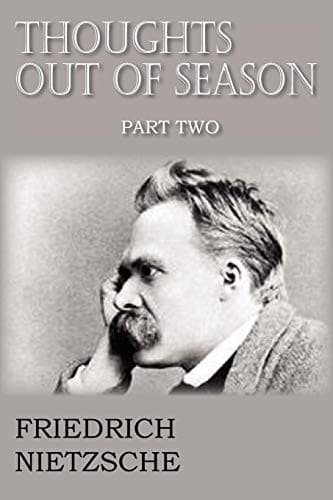
Thoughts Out of Season, Part IINietzsche, Friedrich Wilhelm
PhilosophyPhilosophy
Thoughts Out of Season, Part II
Nietzsche, Friedrich Wilhelm
History -- Study and teaching; Schopenhauer, Arthur, 1788-1860
These thoughts are "out of season," because I am trying to represent
something of which the age is rightly proud--its historical
culture--as a fault and a defect in our time, believing as I do that
we are all suffering from a malignant historical fever and should at
least recognise the fact. But even if it be a virtue, Goethe may be
right in asserting that we cannot help developing our faults at the
same time as our virtues; and an excess of virtue can obviously bring
a nation to ruin, as well as an excess of vice. In any case I may be
allowed my say. But I will first relieve my mind by the confession
that the experiences which produced those disturbing feelings were
mostly drawn from myself,--and from other sources only for the sake
of comparison; and that I have only reached such "unseasonable"
experience, so far as I am the nursling of older ages like the Greek,
and less a child of this age. I must admit so much in virtue of my
profession as a classical scholar: for I do not know what meaning
classical scholarship may have for our time except in its being
"unseasonable,"--that is, contrary to our time, and yet with an
influence on it for the benefit, it may be hoped, of a future time.
I.
Consider the herds that are feeding yonder: they know not the meaning
of yesterday or to-day, they graze and ruminate, move or rest, from
morning to night, from day to day, taken up with their little loves
and hates, at the mercy of the moment, feeling neither melancholy nor
satiety. Man cannot see them without regret, for even in the pride of
his humanity he looks enviously on the beast's happiness. He wishes
simply to live without satiety or pain, like the beast; yet it is all
in vain, for he will not change places with it. He may ask the
beast--"Why do you look at me and not speak to me of your happiness?"
The beast wants to answer--"Because I always forget what I wished to
say": but he forgets this answer too, and is silent; and the man is
left to wonder.
Public-domain text, read in full here on John Shaqi.
Reviews
Reviews
No reviews yet
Be the first to share your thoughts on this work.
Join the Discussion
Join the discussion
Sign in to leave a comment or review.
Sign InorCreate an account