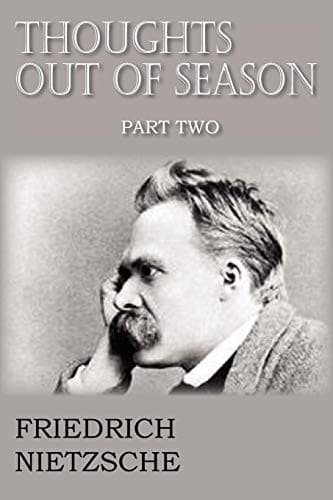
Thoughts Out of Season, Part IINietzsche, Friedrich Wilhelm
PhilosophyPhilosophy
Thoughts Out of Season, Part II
Nietzsche, Friedrich Wilhelm
History -- Study and teaching; Schopenhauer, Arthur, 1788-1860
savant to the people"; whereas in reality he has only "descended" to
himself, so far as he is not a savant but a plebeian. Rise to the
conception of a people, you learned men; you can never have one noble
or high enough. If you thought much of the people, you would have
compassion towards them, and shrink from offering your historical
aquafortis as a refreshing drink. But you really think very little of
them, for you dare not take any reasonable pains for their future;
and you act like practical pessimists, men who feel the coming
catastrophe and become indifferent and careless of their own and
others' existence. "If only the earth last for us: and if it do not
last, it is no matter." Thus they come to live an _ironical_
existence.
VIII.
It may seem a paradox, though it is none, that I should attribute a
kind of "ironical self-consciousness" to an age that is generally so
honestly, and clamorously, vain of its historical training; and
should see a suspicion hovering near it that there is really nothing
to be proud of, and a fear lest the time for rejoicing at historical
knowledge may soon have gone by. Goethe has shown a similar riddle in
man's nature, in his remarkable study of Newton: he finds a "troubled
feeling of his own error" at the base--or rather on the height--of
his being, just as if he was conscious at times of having a deeper
insight into things, that vanished the moment after. This gave him a
certain ironical view of his own nature. And one finds that the
greater and more developed "historical men" are conscious of all the
superstition and absurdity in the belief that a people's education
need be so extremely historical as it is; the mightiest nations,
mightiest in action and influence, have lived otherwise, and their
youth has been trained otherwise. The knowledge gives a sceptical
turn to their minds. "The absurdity and superstition," these sceptics
say, "suit men like ourselves, who come as the latest withered shoots
of a gladder and mightier stock, and fulfil Hesiod's prophecy, that
men will one day be born gray-headed, and that Zeus will destroy that
generation as soon as the sign be visible." Historical culture is
really a kind of inherited grayness, and those who have borne its
mark from childhood must believe instinctively in _the old age of
mankind_. To old age belongs the old man's business of looking back
and casting up his accounts, of seeking consolation in the memories
of the past,--in historical culture. But the human race is tough and
persistent, and will not admit that the lapse of a thousand years, or
a hundred thousand, entitles any one to sum up its progress from the
past to the future; that is, it will not be observed as a whole at
all by that infinitesimal atom, the individual man. What is there in
a couple of thousand years--the period of thirty-four consecutive
human lives of sixty years each--to make us speak of youth at the
beginning, and "the old age of mankind" at the end of them? Does not
Public-domain text, read in full here on John Shaqi.
Reviews
Reviews
No reviews yet
Be the first to share your thoughts on this work.
Join the Discussion
Join the discussion
Sign in to leave a comment or review.
Sign InorCreate an account